


You know the thing needs to get done.
You want it to be done.
You may have been thinking about doing it for three days. You have mentally completed it approximately 47 times. And yet there you are, sitting on the couch, scrolling your phone while a tiny voice in your head gets progressively louder:
Why can't I just do it?
Maybe it's answering an email. Making the appointment. Putting away the laundry that's been living in the basket long enough to qualify as furniture. Starting the work project you genuinely care about.
From the outside, this can look like procrastination. And if you've spent years being told that you're disorganized, unmotivated, scattered, or "not living up to your potential," you may have internalized a much harsher explanation:
I'm just lazy.
But struggling to begin, organize, prioritize, or complete a task can be a sign of executive dysfunction—difficulty with the mental skills that help you plan, start, focus on, and finish tasks even when you genuinely want to do them. Executive functions include skills such as working memory, planning, organization, task initiation, attention, emotional regulation, and impulse control. CHADD
If that sounds familiar, this is for adults—especially neurodivergent adults, including people with ADHD, autism, anxiety, depression, or learning disabilities—who keep getting stuck and blaming themselves for it. Ahead, we'll look at the signs of executive dysfunction, how it differs from laziness, how it connects to ADHD and task paralysis, why it can hit women in specific ways, the shame it often creates, and the strategies and therapeutic approaches that can help.
And once you understand what's actually happening, you can stop trying to shame yourself into functioning differently and start finding support that actually fits your brain.
What Is Executive Dysfunction and Working Memory?
To understand executive dysfunction, it helps to imagine your brain has its own tiny project manager—its management system for cognitive processes.
This project manager helps you decide what needs to happen, determine which thing should happen first, remember the steps, get started, stay focused, adjust when something changes, and eventually finish the task, functions that rely heavily on the frontal lobe, especially the prefrontal cortex.
When those executive functioning skills aren't working smoothly, knowing what you need to do doesn't necessarily translate into being able to do it.
That's why executive dysfunction in adults can be so confusing. You may be intelligent, capable, creative, and successful in plenty of areas of your life while simultaneously feeling completely defeated by making a dentist appointment.
Executive dysfunction isn't a formal diagnosis by itself. It's a term used to describe difficulties with executive functioning, and those difficulties can occur with ADHD as well as autism, anxiety, depression, learning disabilities, temporary stress, and other conditions. CHADD
If you’re interested in seeking support for executive dysfunction visit our Neurodivergent Therapy page.
What Are the Signs of Executive Dysfunction?
The signs of executive dysfunction don't always look dramatic. Often, these common signs show up in the small moments of everyday life that leave you wondering why seemingly simple things feel so hard, especially in tasks involving planning, remembering, and managing time.
Common executive dysfunction symptoms can include:
Knowing what you need to do but struggling to start
Frequently procrastinating until a deadline creates enough urgency
Becoming overwhelmed when a task has multiple steps, since difficulty planning and organizing tasks is a common symptom
Difficulty deciding what to prioritize
Losing track of time or showing poor time management skills
Forgetting appointments, deadlines, or things you intended to do; working memory challenges can also mean forgetting instructions
Struggling to transition from one activity to another, reflecting cognitive flexibility or set shifting
Starting many things and finishing very few
Difficulty organizing your space, schedule, or thoughts
You may lose track of what you were doing midway through a task
Feeling disproportionately overwhelmed by mundane responsibilities
Struggling to regulate frustration or emotions when things don't go according to plan, including emotional dysregulation
Executive functioning includes skills related not only to organization and productivity, but also working memory, task initiation, self-monitoring, inhibitory control as resisting distractions and impulses, and emotional regulation. CHADD
So executive dysfunction can affect much more than your to-do list.
Executive Dysfunction vs. Laziness: How Can You Tell the Difference?
Let's retire the moral judgment for a moment.
"Laziness" isn't a particularly useful clinical explanation for behavior. When someone tells me, I'm just lazy, I'm much more interested in what happens between I want to do this and I can't seem to start.
With executive dysfunction, there's often a disconnect between intention and action.
You may desperately want to finish the task. You may feel anxious because you aren't doing it. You might think about it constantly. You may even spend more emotional energy feeling guilty about not doing it than the task itself would require.
And still—you can't seem to begin.
That's very different from consciously deciding, I could do that, but it's not important to me, and I'm okay with leaving it undone.
One involves a choice. The other can feel like hitting an invisible wall.
This is one reason shame isn't a particularly effective treatment for executive dysfunction. You probably already know the task matters. Making yourself feel worse about struggling with it doesn't suddenly give your brain access to the executive functioning skills it needs.
"Why Can't I Start Tasks Even When I Want To?"
This is one of the most frustrating experiences I hear about from neurodivergent adults.
You aren't confused about what needs to happen.
The email is open.
The laundry is sitting there.
The document is literally blinking at you.
Just start.
Except your brain doesn't.
Task initiation—the ability to begin an activity—is itself an executive function. Difficulties initiating tasks can therefore occur even when someone understands the task and genuinely intends to complete it. CHADD
Sometimes the task is boring. Sometimes it's too vague. Sometimes there are too many steps, and your brain doesn't know which one is technically "first." Sometimes perfectionism makes beginning feel risky because starting means you could do it incorrectly. Procrastination and low motivation can also be part of executive dysfunction, even when you care about the outcome, and trouble planning can make even simple tasks feel strangely hard to begin.
And sometimes your nervous system is already overloaded, making one more demand feel enormous.
This stuck feeling is often described informally as task paralysis.
You aren't necessarily choosing not to act.
Your brain may be struggling to find the doorway into the task.
What Does Task Paralysis Feel Like?
Imagine you need to clean the kitchen. Easy enough, right?
Except your brain sees:
Unload dishwasher. But the dishwasher has clean dishes. Some of those go in the cabinet. The cabinet is messy. There's also food on the counter. Should you put that away first? But the fridge needs organizing. Wait, there are dishes in the sink. You should probably load those. Except the dishwasher needs unloading first. In that moment, working memory is trying to hold and manipulate each step in real time, but it's a limited capacity system. That makes multi-step tasks feel jammed before you even begin.
Suddenly, "clean the kitchen" isn't one task.
It's 26 tiny decisions wearing a trench coat, which is why even complex tasks can stall out fast.
So instead, you stand there.
Or walk away.
Or open Instagram.
Then comes the shame: Normal people can clean a kitchen. What is wrong with me?
Nothing about that thought helps you clean the kitchen. It simply adds emotional overwhelm to an executive functioning challenge.
For some people, therapy involves learning to recognize that moment and respond with curiosity instead of criticism.
ADHD Executive Dysfunction: Why Is Starting So Hard?
There is a significant relationship between ADHD and executive dysfunction: ADHD is commonly linked to it, and many adults with ADHD experience significant executive function difficulties.
ADHD is a neurodevelopmental disorder with defined diagnostic criteria in the Diagnostic and Statistical Manual of Mental Disorders. Executive dysfunction describes executive function challenges and executive function deficits in cognitive skills, and it can occur for many reasons, including ADHD, autism, and depression. Many people with ADHD experience executive functioning difficulties, but having executive dysfunction does not automatically mean you have ADHD. CHADD
This distinction is useful when people search for executive dysfunction vs. ADHD and wonder whether they're essentially the same thing.
They're not.
Think of ADHD as the broader condition: executive dysfunction is common in individuals with ADHD, but it is not an official symptom label in ADHD criteria, and "executive function disorder" is not a distinct diagnosis separate from ADHD in the diagnostic and statistical manual.
ADHD executive dysfunction can make it difficult to organize, prioritize, initiate tasks, sustain attention, manage time, use working memory, handle memory and organization, regulate emotions, and follow a project all the way through. CHADD
ADHD Procrastination Isn't Always About Motivation
If you've spent your life procrastinating, you've probably received some very helpful advice like:
"Just do it before the last minute."
Groundbreaking.
For someone experiencing ADHD procrastination, waiting isn't necessarily a conscious strategy. Executive functioning difficulties can make starting and completing tasks particularly challenging, and procrastination is a common problem reported by adults with ADHD. CHADD
You may notice that a task feels almost impossible to begin on Tuesday but somehow becomes entirely possible at 10:47 p.m. Thursday when it's due Friday morning.
The deadline didn't magically give you new skills.
It changed the conditions surrounding the task.
Urgency can make something feel immediate and stimulating in a way that a vague future deadline doesn't. This is also why some people with ADHD can focus intensely on an interesting project while feeling unable to start a relatively simple administrative task.
The question isn't always: Why am I not motivated enough?
A more useful question might be: What does my brain need in order to access this task?
Executive Dysfunction in Women Can Be Easy to Miss
For many women, executive dysfunction doesn't necessarily look like the stereotype of ADHD they grew up hearing about.
Instead, they may become extremely good at compensating.
They create elaborate calendars. They triple-check everything. They arrive excessively early because they're terrified of being late. They work twice as hard to stay organized. They become perfectionists, people pleasers, or chronic over-preparers.
From the outside, they look like they're doing beautifully.
Inside, maintaining that appearance can be exhausting.
This is one reason some women don't recognize their ADHD or neurodivergence until adulthood. The question isn't simply whether you've managed to keep your life together.
It's also worth asking:
How much energy has it taken to do so?
Be sure to read our past blog: Why So Many Women Don't Realize They Have ADHD Until Adulthood
When Executive Dysfunction Turns Into Shame
The hardest part of executive dysfunction isn't always the unfinished task.
Sometimes it's the story you've learned to tell yourself about it.
I'm lazy.
I'm unreliable.
I'm a mess.
Everyone else can handle normal life.
I should be better at this by now.
After enough years, those thoughts can start feeling like facts.
This is where I love approaches like Acceptance and Commitment Therapy (ACT). Rather than trying to argue every uncomfortable thought out of existence, ACT can help you notice the story your mind is telling you without automatically allowing it to define you.
Instead of:
I'm lazy.
You might begin noticing:
I'm having the thought that I'm lazy because I'm struggling to start this.
That little bit of space matters.
Your Nervous System and Executive Dysfunction in Everyday Life
Executive functioning doesn't happen in a vacuum.
When you're anxious, chronically stressed, burned out, emotionally overwhelmed, or constantly masking, your available mental resources can feel thinner.
Anxiety, depression, stress, and other mental health conditions can contribute to executive functioning difficulties even in people who don't have ADHD, and depression can directly contribute to these symptoms. CHADD
This is why I don't love treating executive dysfunction as purely a productivity problem.
Sometimes you need a better calendar.
And sometimes you need to understand why opening your email makes your entire body tense.
If a task carries years of shame, perfectionism, fear of disappointing someone, or memories of being criticized for doing things "wrong," there may be more happening than a lack of organizational skills, including broader mental health or psychiatric conditions and mood disorders.
Therapy gives us space to explore both.
For some clients, brainspotting can also be one tool for exploring the emotional or nervous-system responses connected to experiences that feel disproportionately activating or difficult.
Practical Strategies: How to Work With Executive Dysfunction Instead of Against It
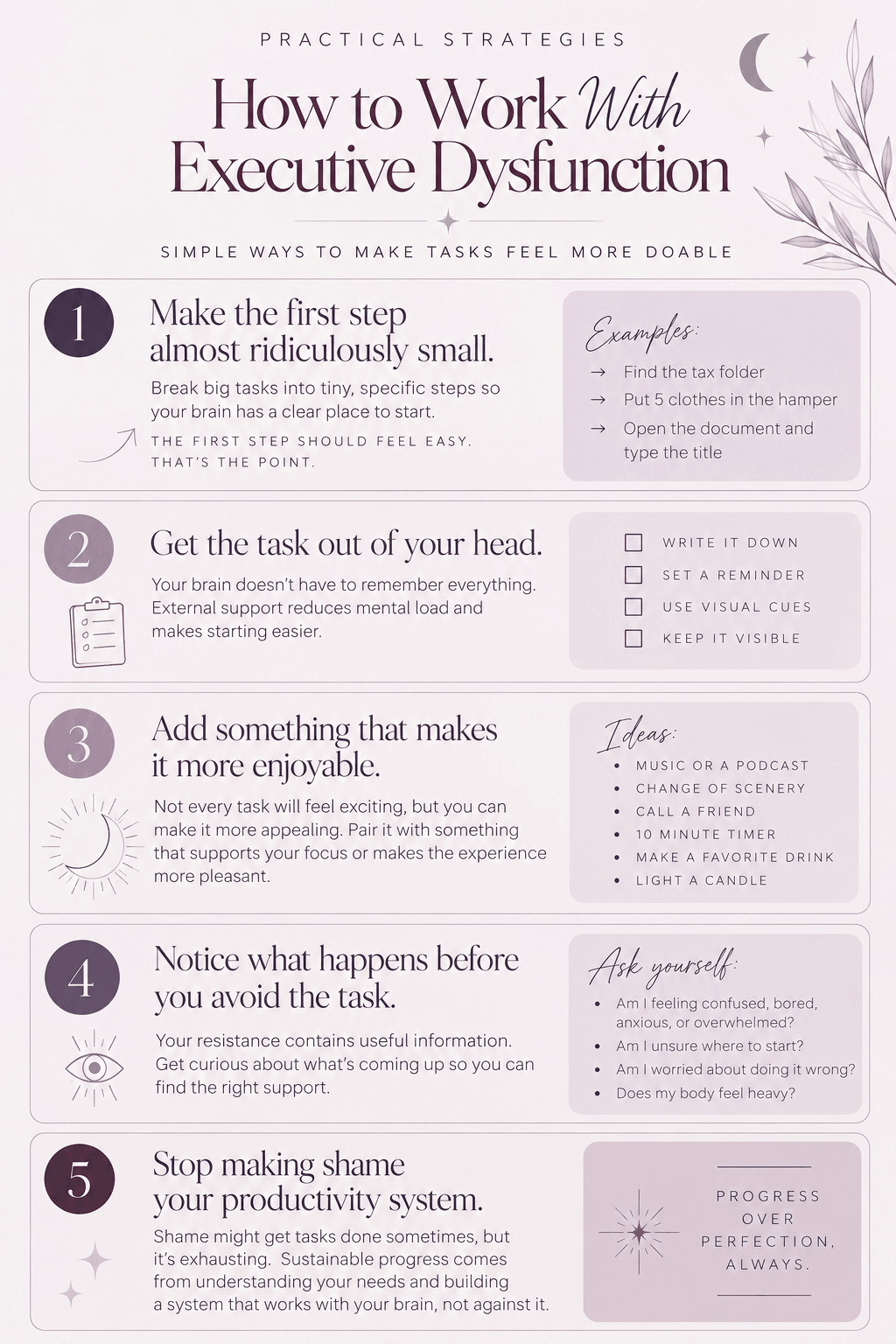
You don't have to become a different kind of person before you're allowed to function well. Often, the goal isn't to force yourself to become more disciplined or organized—it's to reduce the amount of executive functioning a task requires in the first place.
Make the First Step Almost Ridiculously Small
Instead of telling yourself to "do taxes," start by finding the tax folder. Rather than "clean the bedroom," put five pieces of clothing in the hamper. And instead of "write the report," open the document and type the title.
Breaking larger projects into smaller pieces is a commonly recommended strategy for adults with ADHD who struggle with procrastination, time management, and complex projects. CHADD The first step should feel almost laughably achievable. That's the point. You're giving your brain a clear place to begin instead of asking it to figure out an entire project at once.
Get the Task Out of Your Head
Working memory is part of executive functioning. If you're trying to remember twelve tasks, prioritize them, estimate how long they'll take, and figure out when to do them all, you're asking your brain to juggle quite a bit at once. CHADD
Try moving some of that mental load outside of your brain. Write things down, use visual reminders, set alarms, or leave something you need in a place where you'll actually see it. The goal isn't to create the world's most beautiful color-coded productivity system. It's simply to make remembering and starting require a little less effort. External support isn't cheating, and your planner does not award bonus points for suffering.
Add Something That Makes a Boring Task Easier
Not every task is going to become interesting, but you can experiment with making it slightly more appealing. Put on music while you clean, take your laptop outside for a change of scenery, call a friend while you fold laundry, or make your favorite drink before sitting down with paperwork. A visual timer can also help turn an overwhelming task into something more concrete: I'm not cleaning the entire kitchen. I'm doing what I can for ten minutes.
And yes, light the candle if you want to. Put on the ridiculously specific playlist. Use the cute pens. We are allowed a little whimsy. If something makes your brain more willing to approach the task, it counts.
Notice What Happens Before You Avoid the Task
This one is especially important because avoidance often contains useful information. The next time you notice yourself unable to start something, pause before deciding you're procrastinating because you're lazy.
What happens when you think about beginning? Do you feel confused about where to start? Bored before you've even begun? Anxious or overwhelmed? Do you immediately worry you'll do it wrong? Does your body suddenly feel heavy? Or do you inexplicably develop an urgent desire to reorganize a drawer that hasn't bothered you in six years?
Instead of immediately judging that reaction, get curious about it. Understanding why a particular task creates resistance can help you figure out what kind of support you actually need.
Stop Making Shame Your Productivity System
Maybe shame has worked occasionally. You avoid something until the situation becomes unbearable, tell yourself terrible things, panic, complete the task at the last possible moment, and then experience enormous relief. Technically, the task got done—but that's an exhausting way to move through your life.
Support tends to work better when it's built around how your brain actually functions, rather than repeatedly punishing yourself for having the brain you have. The goal isn't to eliminate every struggle with procrastination or executive dysfunction. It's to build enough understanding, compassion, and practical support that getting things done doesn't always require a crisis first.
Executive Dysfunction Isn't a Character Flaw
If you've spent years asking "Why can't I start tasks?", I want you to consider a different possibility.
Maybe the problem isn't that you don't care enough.
Maybe you aren't lazy.
Maybe your brain has been working incredibly hard to navigate tasks that require more executive functioning from you than anyone realized.
Understanding that doesn't mean abandoning responsibility. It means replacing shame with useful information.
From there, we can start experimenting.
What makes beginning easier? What overwhelms your system? What support helps? What expectations were never realistic for you in the first place? What parts of yourself have you been masking to appear more organized, productive, or "together"?
Those are much more interesting questions than:
Why can't I just try harder?
ADHD & Neurodivergent Therapy in Oregon
If executive dysfunction, task paralysis, ADHD procrastination, anxiety, or emotional overwhelm are making everyday life feel much harder than it looks from the outside, therapy can be a place to understand what's underneath the struggle.
I work with women throughout Oregon using evidence-informed therapy alongside holistic and spiritual approaches to help you better understand your nervous system, release emotional overwhelm, unmask from ADHD and neurodivergence, and build life skills that actually work with your brain. The right support may include cognitive behavioral therapy (CBT), ADHD medication, or occupational therapy depending on the person, and it can make a real difference in executive functioning and daily life.
You don't need another person telling you to buy a planner.
We can get curious about why the planner keeps ending up untouched in a drawer in the first place, and whether body doubling might help with focus and finishing tasks.
Frequently Asked Questions About Executive Dysfunction
What is executive dysfunction?
Executive dysfunction is a term used to describe difficulty with executive functioning skills, meaning the brain’s management system for cognitive processes is disrupted, which can affect a person's ability with planning, organization, working memory, attention, task initiation, emotional regulation, self-monitoring, and problem solving. It isn't a standalone medical diagnosis and can occur alongside ADHD, autism, anxiety, depression, stress, and other conditions. CHADD
What is the difference between executive dysfunction vs. ADHD?
ADHD is a neurodevelopmental disorder with specific diagnostic critea, while executive dysfunction describes difficulty using certain cognitive skills. Executive functioning challenges are common with ADHD, but you can experience executive dysfunction without having ADHD. CHADD
Is task paralysis a symptom of ADHD?
People with ADHD can experience significant difficulty initiating tasks, prioritizing steps, sustaining attention, and completing projects. What people commonly call task paralysis can reflect challenges with these executive functioning skills, although experiencing it alone doesn't mean someone has ADHD. CHADD
Why can't I start tasks even when I want to?
Difficulty starting a task can involve task initiation, which is an executive function. Anxiety, perfectionism, overwhelm, depression, stress, ADHD, and other factors can also make starting more difficult, so the reason isn't always simply a lack of motivation. CHADD
Can therapy help with ADHD executive dysfunction?
Therapy can help you better understand the emotional and behavioral patterns surrounding executive functioning challenges, reduce shame, develop strategies that fit the way you function, and address coexisting concerns such as anxiety or emotional overwhelm. If you're wondering whether your symptoms are caused by ADHD, a qualified clinician can also help determine whether a formal ADHD evaluation is appropriate and support an accurate diagnosis; for some people, medication can also assist with executive dysfunction symptoms, especially when ADHD is part of the picture. For further information, ask about brochures, helplines, or local support groups.

About Tori Gorman
Clinical Social Work/Therapist, MSW, LCSW, LICSW
Tori is a licensed therapist and founder of Soul Spirit Therapy, providing virtual therapy for adults throughout Oregon. She specializes in supporting neurodivergent adults navigating ADHD, anxiety, burnout, trauma, nervous system dysregulation, and life transitions through a holistic, affirming approach that integrates evidence-based therapies with nervous system regulation, Brainspotting, Internal Family Systems (IFS), and intuitive practices. Tori is passionate about helping sensitive, deep-feeling humans reconnect with themselves, heal from survival mode, and build lives that honor the way they naturally move through the world.
If you're looking for compassionate, neurodivergent-affirming therapy in Oregon, schedule a consultation to learn more about working together.