
Moon Cycles & Emotional Regulation: A Grounded Way to Work With the Moon
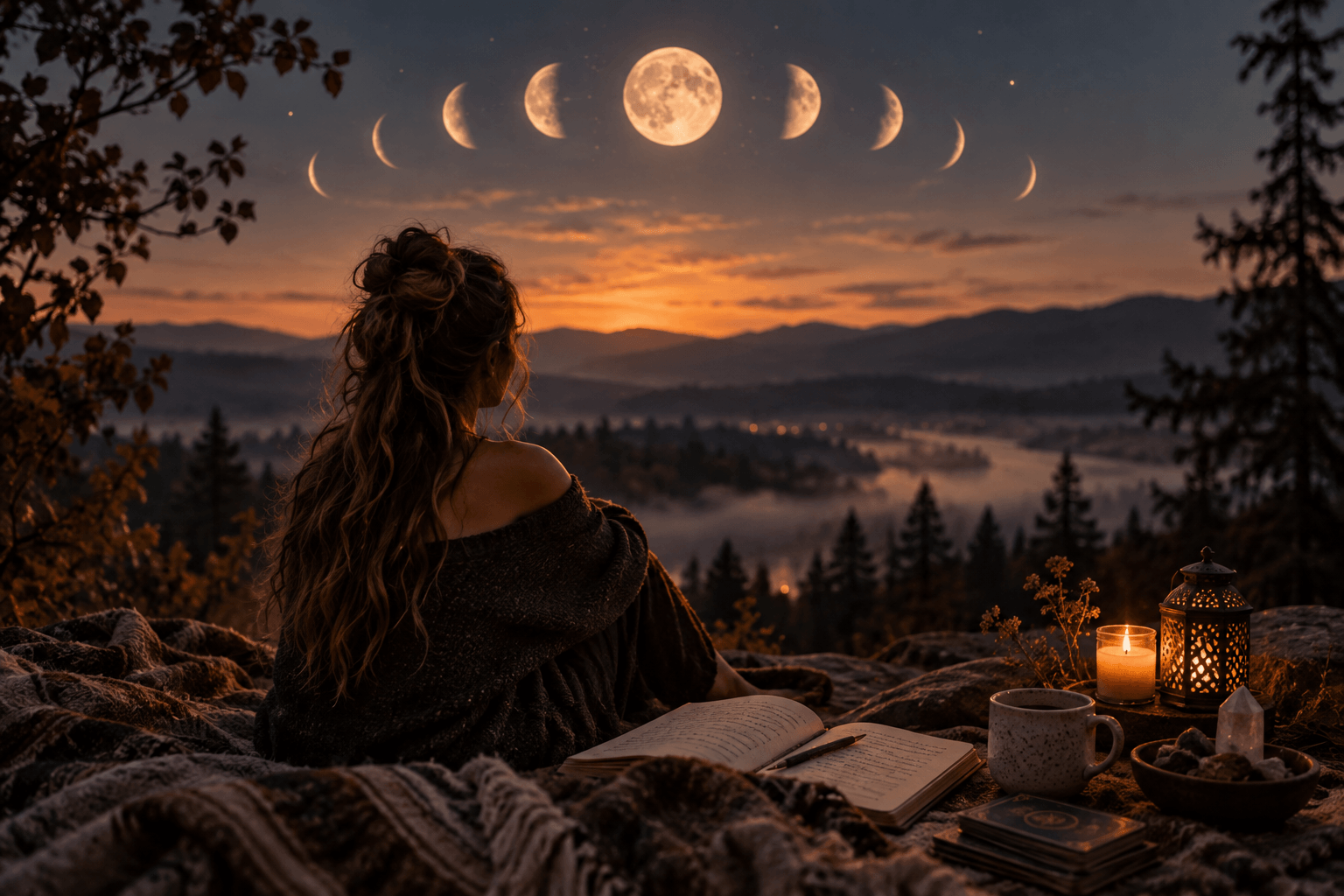
There is something undeniably lovely about looking up and realizing the moon has changed again.
Maybe you notice a tiny crescent outside your window while you're washing dishes. Maybe the full moon catches you on your evening walk, and you immediately text a friend, Okay, THAT explains everything.
As someone who makes room for spirituality alongside evidence-informed therapy, I understand the appeal.
For centuries, humans have used the moon to mark time, create rituals, and assign meaning to different seasons of life. Today, you might hear conversations about moon cycles & emotional regulation, see a moon mood calendar on social media, or wonder whether the moon really is responsible for the emotional chaos you've been feeling all week.
But here's where I like to bring a little grounding into the magic: there isn't strong evidence that moon phases directly regulate our emotions or reliably cause changes in mental health. That doesn't mean your relationship with the moon has to be meaningless.
Instead of asking the moon to control your emotional life, what if you used its changing phases as an invitation to notice it?
For women navigating anxiety, ADHD, emotional overwhelm, burnout, or simply a desire to feel more connected to themselves, the lunar cycle can become a gentle rhythm for reflection. In this article, we'll explore moon cycles and emotional regulation, moon phases' spiritual meaning and symbolism, whether the moon affects mood, and simple rituals you can use to check in with your nervous system without spiritually bypassing what you're actually feeling.
Read our recent blog post: Can Spirituality and Therapy Work Together?
Do Moon Phases Affect Emotions?
Let's start with the question everyone really wants answered: Was it actually the full moon?
Probably not in the straightforward way TikTok might have you believe.
Research has not established that different lunar phases consistently cause anxiety, irritability, emotional dysregulation, or other predictable mood changes across the general population.
So if you're searching for information about the moon affecting mood, I'd be cautious about treating a particular moon phase as the explanation for how you're feeling.
Your emotional state can be influenced by so many things: sleep, hormones, chronic stress, sensory overload, relationships, trauma triggers, your environment, physical health, and whether you've been running entirely on iced coffee and determination for the last four days.
The moon doesn't need to be causing your emotions to help you notice them.
And that's the distinction I find much more useful therapeutically.
Moon Phases, Spiritual Meaning, and Symbolism
The moon's changing appearance has made it a powerful symbol of cycles, transition, release, darkness, renewal, and growth across different cultures and spiritual traditions.
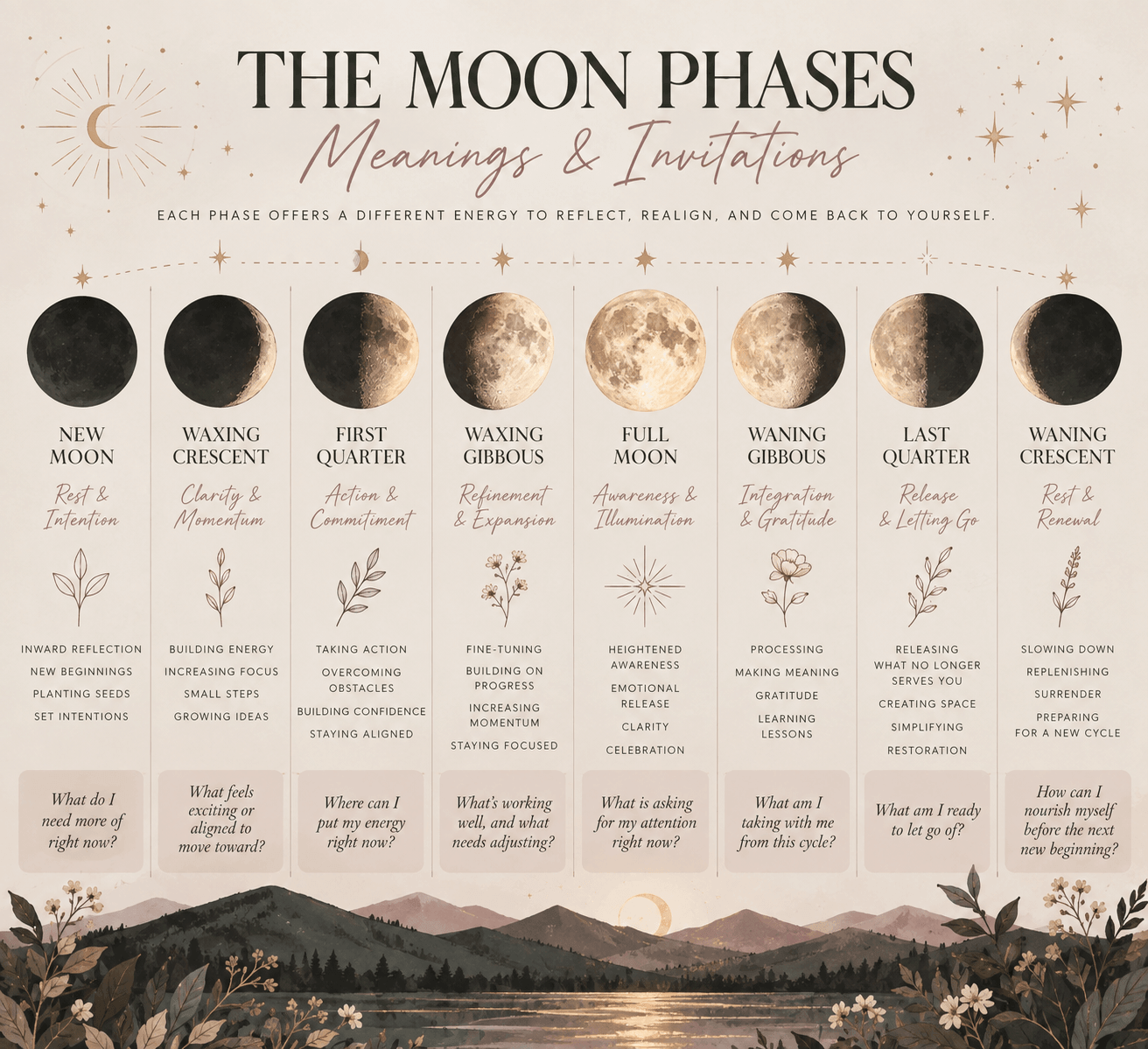
Today, you'll find many modern spiritual practices assigning a particular intention or theme to each phase. These interpretations aren't universal psychological truths, but you can use moon phases symbolism as a framework for reflection if it feels meaningful to you.
New Moon: Rest & Intention
The darkness of a new moon is often associated with new beginnings, rest, inward reflection, and setting intentions.
Rather than creating an enormous list of everything you're going to manifest by next month, try something gentler as a form of self care: What do I need more of right now?
Maybe it's rest. Creativity. Boundaries. Connection. Quiet.
You don't have to immediately turn the answer into another goal. Sometimes noticing is enough.
Waxing Moon: Growth & Action
As more of the moon becomes visible, the waxing crescent, an early phase within the waxing moon period, is often associated with building, creating, and moving toward something.
This can be a lovely time to ask:
Where do I actually have energy right now? You might also try daily affirmations as a simple way to reflect during this phase.
If you have ADHD, this can be particularly interesting. Instead of judging yourself for inconsistent energy or productivity, experiment with noticing your natural rhythms.
What feels easy right now? What feels difficult? What are you forcing?
Working with this phase can also support emotional resilience without forcing productivity.
Full Moon: Awareness & Illumination
Spiritually, the full moon is often associated with illumination, heightened awareness, and seeing something more clearly.
Many people believe the full moon has an influence on human emotions, even though the evidence for that is limited.
I like the word awareness here.
Rather than assuming the full moon is making you emotional, notice how, in the same way people form an illusory correlation from selective observations, it's easy to mistake timing for cause. You can use it as a recurring reminder to ask: What has been asking for my attention lately?
Maybe you've been more irritable because you're overscheduled. Perhaps resentment is showing you where you need a boundary. Maybe your anxiety has been louder because you haven't had a quiet moment to yourself in weeks.
Your emotions don't necessarily need to be fixed. Sometimes they need to be heard.
Waning Moon: Release & Restoration
As the visible moon begins getting smaller, the waning phases are often associated with release, letting go, and turning inward to reflect on lessons learned before moving forward.
But I want to be careful with the idea of "releasing" emotions.
Healing doesn't require you to perform a full-moon ritual and magically release the grief, anger, anxiety, or trauma you've carried for years.
Some experiences need to be processed rather than banished. This phase can also support restoration through gentler practices.
Instead, you might ask: What am I carrying that I'm ready to put down?
Perhaps it's an obligation. An unrealistic expectation. A habit of saying yes when you mean no. Or the belief that rest needs to be earned.
What Do Moon Cycles Have to Do With Emotional Regulation?
Emotional regulation isn't about remaining calm all the time.
It's the ability to notice, understand, and respond to emotions without automatically becoming consumed by them or trying to make them disappear.
That's where I think lunar practices can become genuinely useful. The moon gives us something many overwhelmed women desperately need: a recurring invitation to check in.
You could use the new moon and full moon as twice-monthly reminders to journal. You might create a small ritual where you make tea, put your phone away, pull a tarot card, and spend ten minutes noticing what's happening internally.
The ritual itself isn't magically regulating your nervous system because it corresponds with a particular lunar phase, though different phases can still serve as recurring prompts.
It's creating intentional space for awareness. And when your normal speed is approximately seventeen browser tabs open simultaneously, intentional pauses matter.
Using a Moon Mood Calendar Without Letting It Tell You How to Feel
A moon mood calendar can be an interesting self-reflection practice, especially if you approach it with curiosity rather than confirmation.
For one or two lunar cycles, track:
Your mood and general energy.
Sleep quality.
Anxiety or emotional overwhelm.
Sensory sensitivity.
Menstrual cycle, if relevant to you.
Significant stressors or relationship events.
Your wake time.
The current lunar phase.
Then look back at what you recorded.
The goal isn't to prove that the moon controls your mood or to isolate one dramatic night instead of looking at all the data. It's to notice your patterns.
Maybe you'll discover that you consistently become overwhelmed after several highly social days. Perhaps your anxiety increases when your sleep declines. Maybe certain parts of your menstrual cycle have a stronger relationship with your emotional state than the lunar cycle does.
Or perhaps tracking the moon simply gives you a beautiful rhythm for checking in with yourself. That has value too.
Moon Cycles and Witchcraft
If you've been searching for moon cycles and witchcraft, you've probably encountered rituals involving intention setting, manifestation, cleansing, tarot, crystals, spellwork, journaling, or releasing practices.
For some people, witchcraft is connected to religion or a deeply held spiritual tradition. For others, modern witchcraft practices provide rituals, symbolism, creativity, or a way to feel connected to nature and themselves.
Therapy doesn't need to determine whether those practices are "real enough" to matter.
What I'm interested in is how a practice functions in your life.
Does it help you slow down?
Does it encourage reflection?
Does it connect you with your values?
Does it help you feel more grounded and present?
Or does it create fear, compulsive checking, pressure to interpret every coincidence as a sign, or the belief that you're responsible for preventing bad things through ritual?
Spiritual practices should create more room for your humanity—not make you afraid of getting spirituality "wrong."
How Can You Use the Moon Cycle for Self-Reflection?
You don't need an elaborate altar or a perfect moon ritual.
Try choosing one recurring lunar phase—perhaps the new moon or full moon—and use it as your reminder to pause.
Make tea. Light a candle. Sit outside if the weather cooperates, and notice the moon in the night sky. Grab your journal, tarot deck, or simply yourself.
Then ask:
What am I feeling that I haven't made space for?
What has been draining me lately?
Where have I felt most like myself?
Where am I overriding my own needs?
What would feel supportive during the next few weeks?
If you want more structure, you can follow a simple moon guide. You don't need profound answers. You are simply practicing listening.
For women who have spent years masking ADHD, people pleasing, or prioritizing everyone else's emotional needs, that practice can be surprisingly powerful.
What Should You Do During a Full Moon for Emotional Release?
If full-moon rituals appeal to you, I recommend thinking about processing and reflection rather than forcing yourself to "release negative energy."
You might journal about something you've been carrying, practice gentle stretching, spend time outside, meditate, pull tarot cards for reflection, or identify a boundary you'd like to practice. If you want a little more structure, tai chi can offer the same kind of grounding through slow, mindful movement.
You could also write down something you're ready to loosen your grip on—not because writing it down magically erases it, but because naming something can clarify what you're ready to change.
And if what comes up feels bigger than something a journal or ritual can hold?
That's information too.
You don't need to process trauma alone simply because you're spiritual.
Spirituality Without Spiritual Bypassing
An important part of exploring moon phases spiritual meaning is making sure spirituality supports your emotional wellness rather than becoming a way to avoid what you're actually feeling. Spiritual practices can give us meaning, ritual, connection, hope, and moments of wonder, but they can also become a surprisingly easy way to skip over uncomfortable emotions.
If you're hurt, you don't need to immediately "raise your vibration." If you're angry, you don't have to turn it into gratitude before you've had a chance to understand where that anger is coming from. An unhealthy relationship doesn't require another sign from the universe before you're allowed to acknowledge that something isn't working. And anxiety isn't necessarily Mercury, the moon, or evidence that you aren't manifesting correctly.
Sometimes the most meaningful spiritual practice is simply being honest with yourself: I'm exhausted. That hurt me. I'm angry. I need help. I don't want this anymore.
Spirituality and therapy can coexist beautifully when your spiritual practices give you another language for understanding yourself, rather than another reason to avoid the parts of your experience that feel difficult or painful.
How Can Spiritual Practices Support Emotional Regulation?
Spirituality can become part of emotional regulation when the practices you choose help you slow down, become present, connect with the human body, or reflect on your internal experience.
That might include mindfulness, meditation, journaling, tarot, time in nature, intuitive practices, meaningful rituals, or simply watching the moon change across the night from your backyard to strengthen a reflective sense of presence.
I often integrate holistic and spiritual modalities alongside evidence-informed therapy because I don't believe you have to choose between understanding your nervous system and honoring your intuitive side.
You can learn about your attachment patterns and pull tarot cards.
You can practice nervous system regulation and light the candle.
You can understand ADHD and still find meaning in ritual.
The magic doesn't have to disappear just because we're grounded, and some people relate to moon's energy as a symbolic or personally meaningful part of that experience rather than a scientific claim.
Let the Moon Be a Reminder to Come Back to Yourself
Maybe the moon isn't controlling your emotions.
Maybe it doesn't need to.
There is something beautiful about having a natural rhythm that reminds you to look up from your life every once in a while.
To notice what's changed. To notice what hasn't.
To ask what you're carrying, what you need, and whether the way you're currently living still feels like you.
For women who spend much of their lives managing, achieving, masking, anticipating, and caring for everyone else, perhaps that's where moon cycles and emotional regulation can meet.
Not in believing that the moon determines how you feel.
But in allowing it to remind you to ask.
Looking for Holistic Therapy in Oregon?
If you're looking for therapy that makes room for your spiritual side without asking you to bypass your emotions, I'd love to support you.
I work with women throughout Oregon who are navigating anxiety, ADHD, emotional overwhelm, burnout, and feeling disconnected from themselves. Our work can combine evidence-informed therapy with holistic tools like nervous system regulation, mindfulness, tarot, intuition, and spiritual exploration based on what feels meaningful to you.
Frequently Asked Questions About Moon Cycles & Emotional Regulation
Do moon phases actually affect your emotions?
Research hasn't established a consistent relationship between lunar phases and changes in mood across the general population. However, using moon phases as recurring opportunities for reflection can help you become more aware of your emotions, stress, energy, and needs.
What is the spiritual meaning of the moon phases?
There isn't one universal meaning. In many contemporary spiritual practices, the new moon symbolizes beginnings and intention, waxing phases represent growth, the full moon represents illumination or awareness, and waning phases symbolize release and restoration. These are symbolic frameworks rather than psychological rules.
How can I use the full moon for emotional regulation?
Instead of assuming the full moon is causing heightened emotions, use it as a reminder to check in with yourself. A 2013 study found about 30% less NREM sleep and roughly 20 minutes less total sleep around full moons, though the evidence is limited rather than definitive. Some studies also suggest sleep starts later before a full moon, with less deep sleep and delayed REM sleep. Journaling, mindfulness, gentle movement, tarot, time outside, or simply identifying what has been emotionally draining you can turn the ritual into a meaningful form of self-reflection.
Can I incorporate moon rituals, tarot, or witchcraft into therapy?
You can discuss spiritual practices with a therapist who is comfortable integrating them into treatment. A holistic therapist may use your beliefs, rituals, symbolism, or tarot as tools for reflection while still using evidence-informed therapeutic approaches.
Can the moon affect anxiety or ADHD symptoms?
There isn't good evidence that lunar phases directly cause ADHD or anxiety symptoms. If you notice a pattern, tracking the moon alongside sleep patterns, stress, sensory demands, menstrual cycles, routines, and other factors can give you a more complete picture of what may be influencing how you feel, although some studies suggest sleep may start later before a full moon and that still is not strong evidence that lunar phases directly cause anxiety or ADHD symptoms.

About Tori Gorman
Clinical Social Work/Therapist, MSW, LCSW, LICSW
Tori is a licensed therapist and founder of Soul Spirit Therapy, providing virtual therapy for adults throughout Oregon. She specializes in supporting neurodivergent adults navigating ADHD, anxiety, burnout, trauma, nervous system dysregulation, and life transitions through a holistic, affirming approach that integrates evidence-based therapies with nervous system regulation, Brainspotting, Internal Family Systems (IFS), and intuitive practices. Tori is passionate about helping sensitive, deep-feeling humans reconnect with themselves, heal from survival mode, and build lives that honor the way they naturally move through the world.
If you're looking for compassionate, neurodivergent-affirming therapy in Oregon, schedule a consultation to learn more about working together.