

Inner Child Healing: Why Childhood Patterns Still Show Up in Adult Relationships

If you've been exploring inner child healing, you may have started asking yourself an important question:
"Why do I keep reacting this way in my relationships?"
Maybe your partner asks a simple question, and you immediately become defensive.
Maybe a friend takes longer than usual to text back, and you convince yourself they're upset with you.
Maybe you find yourself apologizing for things that aren't your responsibility, avoiding conflict at all costs, or working overtime to make sure everyone around you is happy—even when it's costing you your own peace.
You know these reactions don't always match the situation. Yet they feel impossible to stop.
As a therapist, I often remind clients that these reactions don't mean you're broken. More often, they are protective patterns your nervous system developed long ago.
For many women, the emotional triggers that show up in adult relationships aren't really about what's happening today. They're echoes of what once felt necessary to survive.
This article is for women who find themselves caught in cycles of people pleasing, anxiety, emotional overwhelm, or repeating the same relationship patterns over and over again. We'll explore how childhood trauma in adults can shape the way we relate to ourselves and others, what a wounded inner child actually looks like, the five inner child wounds that often appear in adulthood, and how therapies like Brainspotting, Parts Work (IFS), and Trauma Therapy can support lasting healing.
What Is Your Inner Child?
Your inner child isn't a literal child living inside you.
Instead, it represents the younger parts of yourself that still carry the emotions, beliefs, and survival strategies you developed early in life. These parts remember experiences long after you've grown up.
They remember what it felt like to be criticized. To feel unseen. To become the peacekeeper. To believe love had to be earned. To hide parts of yourself in order to feel accepted.
Your adult mind may know those experiences are over. But your nervous system may still respond as though they're happening today.
How Does Having a Wounded Inner Child Affect Relationships?
This is one of the questions I hear most often.
Many women assume their relationship struggles mean they've chosen the wrong partner or that they're simply "too sensitive." More often than not, neither is true.
A wounded inner child doesn't create relationship challenges because you're immature or incapable of having healthy relationships. Instead, it shapes the relationship patterns you carry into adulthood because younger parts of you are still trying to keep you safe.
You might notice yourself:
Feeling rejected when your partner simply needs space.
Assuming someone is angry with you because their tone changed.
Becoming overwhelmed after even minor conflict.
Constantly seeking reassurance that you're loved.
Feeling responsible for everyone else's emotions.
Struggling to ask for your own needs because you fear being "too much."
Pulling away from people before they have a chance to hurt you.
Staying in relationships long after your needs stop being met.
Feeling guilty every time you set a boundary.
These reactions often happen automatically. They aren't a sign that you're choosing unhealthy patterns or intentionally making relationships harder.
Instead, they're protective responses your nervous system learned long before you had the awareness, support, or tools to respond differently. What helped you feel safe as a child may no longer serve you as an adult, but those patterns can still show up until they're met with understanding and compassion.
The Five Inner Child Wounds
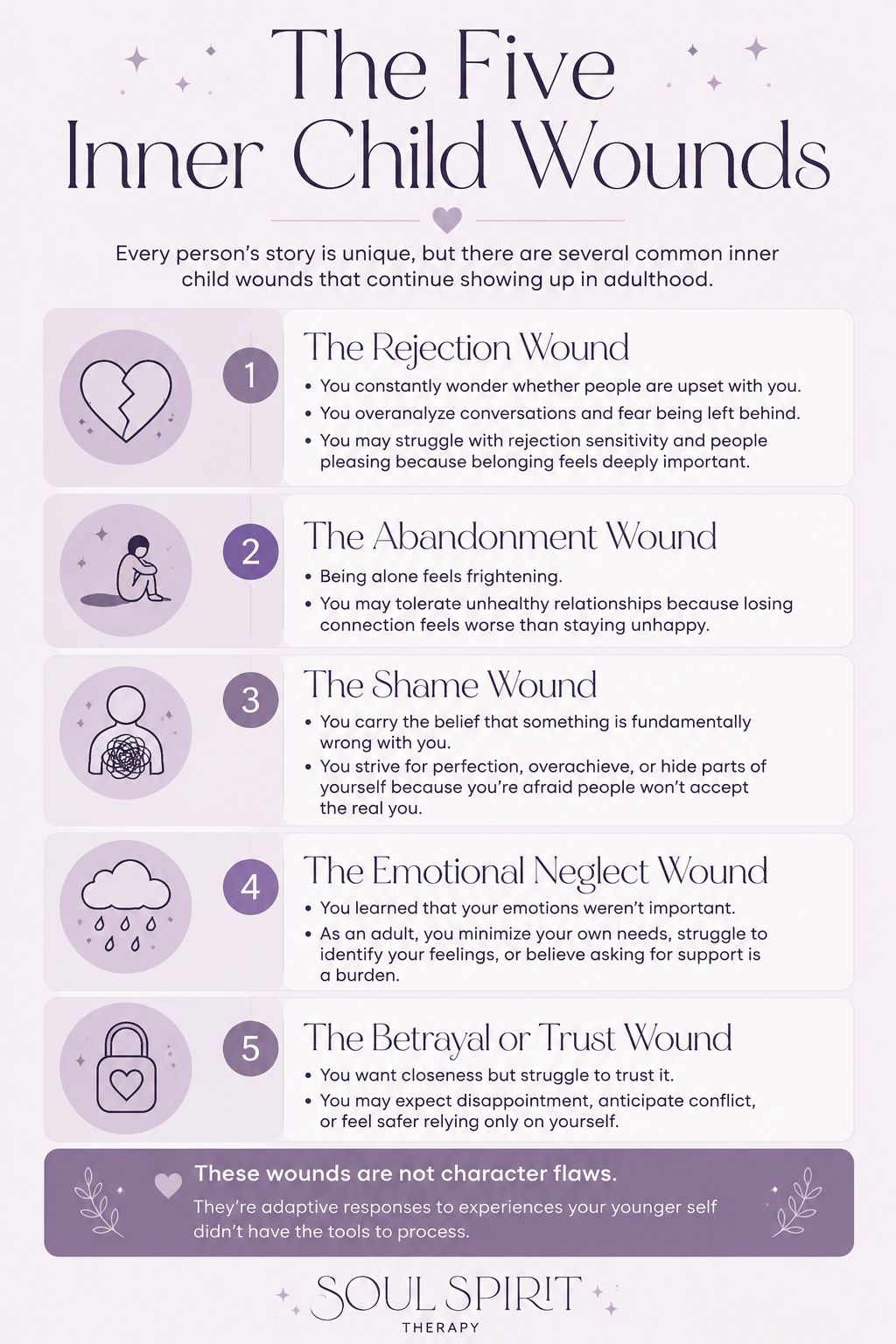
Every person's story is unique, but there are several common inner child wounds that continue showing up in adulthood.
The Rejection Wound
You constantly wonder whether people are upset with you.
You overanalyze conversations and fear being left behind.
You may struggle with rejection sensitivity and people pleasing because belonging feels deeply important.
The Abandonment Wound
Being alone feels frightening.
You may tolerate unhealthy relationships because losing connection feels worse than staying unhappy.
The Shame Wound
You carry the belief that something is fundamentally wrong with you.
You strive for perfection, overachieve, or hide parts of yourself because you're afraid people won't accept the real you.
The Emotional Neglect Wound
You learned that your emotions weren't important.
As an adult, you minimize your own needs, struggle to identify your feelings, or believe asking for support is a burden. Identifying unmet emotional needs can clarify sources of current emotional pain.
The Betrayal or Trust Wound
You want closeness but struggle to trust it.
You may expect disappointment, anticipate conflict, or feel safer relying only on yourself.
These wounds are not character flaws.
They're adaptive responses to experiences your younger self didn't have the tools to process.
Why People Pleasing Often Begins in Childhood
One of the most common relationship patterns I see is people pleasing. Many women believe it's simply part of their personality—that they're naturally caring, accommodating, or "just nice." While those qualities can absolutely be true, people pleasing is often rooted in something much deeper.
For many women, people pleasing began as a survival strategy. Perhaps keeping everyone happy helped reduce conflict at home. Maybe being "the easy child" earned praise or approval, or you learned that your needs came second to everyone else's. Over time, your nervous system began to associate keeping the peace with staying safe.
As an adult, those same protective patterns may show up as:
Saying yes when you desperately want to say no.
Overexplaining your decisions.
Feeling guilty for disappointing someone.
Avoiding difficult conversations.
Constantly monitoring other people's emotions.
While these behaviors may have once protected you, they often leave you emotionally exhausted, disconnected from your own needs, and wondering why relationships feel so draining.

Healing Isn't About Blaming Your Childhood
One of the biggest misconceptions about inner child healing is that it's about blaming your parents or reliving painful memories. It isn't.
Healing is about understanding your story with compassion. It's about acknowledging that difficult experiences shaped you without excusing what happened or allowing those experiences to define who you are today.
Many of the protective strategies your younger self developed were incredibly intelligent. They helped you navigate situations that may have felt confusing, lonely, or unsafe when you didn't have the resources or support you needed. Those patterns served an important purpose.
As adults, however, we have the opportunity to gently ask whether those same strategies are still serving us. Healing isn't about getting rid of those protective parts—it’s about helping them realize they no longer have to carry the weight they once did.
Gradually processing difficult emotions in a safe, supportive environment allows your nervous system to recognize that the danger has passed. From that place of safety, a new question begins to emerge:
"Do I still need these patterns to protect me?"
What Inner Child Healing Looks Like in Therapy
Healing your inner child isn't about becoming someone different. Inner child work often includes reparenting yourself with compassion and safety.
It's about helping the younger parts of yourself finally experience the safety, compassion, and support they may not have received when they needed it most.
In my practice, this often involves a blend of holistic, trauma-informed approaches that honor both the mind and the nervous system, and therapists can help clients develop personalized healing practices rooted in childhood experiences.
Trauma Therapy can help you understand how early experiences continue to shape your emotional responses and relationship patterns while creating space for healing with greater self-compassion. Therapeutic approaches may include Internal Family Systems and cognitive behavioral therapy, and cognitive behavioral therapy can be effective for identifying and changing old beliefs tied to childhood wounds, past events, and the early years.
Brainspotting supports processing experiences that may still feel "stuck" in the nervous system, allowing healing to happen beyond words alone. Somatic awareness, such as body scans, can help release stored emotions connected to the child self.
Internal Family Systems (IFS), also known as Parts Work, helps you build a relationship with the younger protective parts of yourself instead of fighting against them. Visualization can help the adult self create a safe space for the inner child or younger version during sessions or guided exercises. Rather than trying to eliminate anxiety, people pleasing, or perfectionism, we become curious about the role these parts have been trying to play, which is one example of child work that helps the present self comfort a child version and reconnect with childhood memories, including positive experiences from the past.
Together, these approaches help you move from reacting automatically to responding with greater awareness, self-trust, and emotional freedom. Journaling, letter writing, and daily affirmations can uncover hidden beliefs, help rewrite narratives, and shift negative thoughts while supporting self acceptance and self esteem. Self-compassion can reduce self-criticism and ease anxiety and depression during healing. This idea can also help you start healing, set healthy boundaries through daily routines, and building new experiences helps reshape beliefs formed in childhood.
You Don't Need to Become Someone Else
One of my favorite things about inner child healing is that it isn't about fixing yourself.
Your inner child isn't broken. She has simply been carrying stories, fears, and protective strategies that once made perfect sense.
Healing is gently reminding her that she doesn't have to carry them alone anymore. Over time, those emotional triggers lose their intensity.
Relationships begin to feel safer.
Boundaries become easier. You reconnect with joy and spontaneity, which can restore creativity and enthusiasm for life.
You trust yourself more and feel better equipped to face life's challenges as part of this personal journey.
Not because you've become someone new. But because you've finally learned to care for every part of who you've always been.
Ready to Begin Your Inner Child Healing Journey?
If you recognize yourself in these relationship patterns, know that you're not alone.
Healing is possible, and you don't have to untangle these experiences by yourself.
Whether you're navigating anxiety, emotional overwhelm, people pleasing, or the lasting effects of childhood trauma, therapy can help you better understand your nervous system, reconnect with yourself, and create relationships that feel grounded, secure, and authentic.

About Tori Gorman
Clinical Social Work/Therapist, MSW, LCSW, LICSW
Tori is a licensed therapist and founder of Soul Spirit Therapy, providing virtual therapy for adults throughout Oregon. She specializes in supporting neurodivergent adults navigating ADHD, anxiety, burnout, trauma, nervous system dysregulation, and life transitions through a holistic, affirming approach that integrates evidence-based therapies with nervous system regulation, Brainspotting, Internal Family Systems (IFS), and intuitive practices. Tori is passionate about helping sensitive, deep-feeling humans reconnect with themselves, heal from survival mode, and build lives that honor the way they naturally move through the world.
If you're looking for compassionate, neurodivergent-affirming therapy in Oregon, schedule a consultation to learn more about working together.