

Can Spirituality and Therapy Work Together? A Holistic Approach to Mental Health

If you’ve been searching for spiritual therapy, you may be wondering whether there’s a place for intuition, tarot, mindfulness, or your spiritual beliefs inside a therapy session. The answer is yes—therapy and spirituality can work together when they’re integrated thoughtfully and in a way that honors your individual beliefs.
For many of the women I work with, traditional therapy has been helpful, but something still feels like it’s missing. They don’t just want to understand why they feel anxious, overwhelmed, disconnected, or stuck. They want to reconnect with themselves on a deeper level.
Maybe you’re learning to unmask after discovering you have ADHD. Maybe you’ve spent years people pleasing and can barely hear your own intuition underneath everyone else’s expectations. Or perhaps you’re moving through a season where the old version of you no longer quite fits, but the next version hasn’t fully arrived yet.
This is where holistic and spiritual approaches to therapy can create another layer of exploration.
In this article, we’ll explore what spiritual therapy actually means, how a holistic therapist may incorporate tools like tarot, intuition, mindfulness, and nervous system regulation into sessions, and how spiritual practices can complement evidence-informed therapy without bypassing difficult emotions. If you’re a woman looking for therapy that makes room for your mind, body, intuition, and slightly mystical side, this is for you.
What Is Spiritual Therapy?
Spiritual therapy isn't necessarily religious therapy, nor does it require you to follow a particular spiritual practice.
Instead, spiritual healing therapy creates space to explore the parts of your experience that may not fit neatly into traditional conversations about mental health: your intuition, sense of purpose, personal beliefs, connection to something larger than yourself, and the meaning you make from your experiences.
For one person, spirituality may involve meditation or spending time in nature. For another, it might mean tarot, astrology, energy, prayer, ritual, or intuitive development.
And for someone else, spirituality might simply mean learning how to come home to themselves.
There isn't one right way to be spiritual.
What Does a Holistic Therapist Do Differently?
A holistic therapist looks at more than a collection of symptoms.
If you're experiencing anxiety, for example, we aren't only interested in stopping anxious thoughts. We may become curious about what your nervous system is communicating, what patterns have developed in your relationships, whether you're masking parts of yourself, what your body needs, and where you've stopped trusting your own inner voice.
The goal is to understand the whole person through a therapeutic approach that includes emotional, physical, and spiritual dimensions, acknowledging the human spirit as a core dimension of holistic well-being.
In my work, that can mean combining evidence-informed therapeutic approaches with nervous system regulation, mindfulness, Brainspotting, Parts Work, tarot, astrology, and intuitive development depending on what feels appropriate and supportive for the individual client, and in clinical practice that includes incorporating a client's spiritual beliefs, practices, and values into the treatment plan when relevant.
You don't have to leave your spirituality at the door when you enter therapy. The work should support clients without imposing the therapist's own belief system.
You also don't have to leave evidence-informed mental health care behind when you explore spirituality.
There can be room for both.
Can a Therapist Really Use Tarot Cards?
Yes, some therapists incorporate tarot as a tool for reflection and exploration when it aligns with the client's worldview, beliefs, preferences, and goals. This kind of spiritual exploration only belongs in therapy when the client is interested and consents to it, not as a requirement.
In my practice, tarot isn't about handing over your future to a deck of cards. I don't want a card telling you how to live your life any more than I want anxiety telling you how to live it.
Instead, tarot can offer imagery, symbolism, and archetypes that help us explore what's already happening inside you.
Imagine pulling a card and immediately thinking, I don't like this one.
Interesting.
Why?
What does the image bring up? What story are you attaching to it? Does it remind you of a part of yourself you've been avoiding?
Sometimes a card gives us a doorway into a conversation we wouldn't have reached through a question like, "So, how did that make you feel?"
Tarot becomes less about prediction and more about curiosity.
Read our post: Can a Therapist Use Tarot Cards? to learn more.
Intuitive Therapy: Learning to Hear Yourself Again
One of the things I see frequently in women experiencing anxiety, ADHD, or emotional overwhelm is a loss of trust in themselves.
You've spent years wondering:
Am I overreacting?
Should I just let this go?
What if I make the wrong choice?
Is this intuition or anxiety?
If you've spent much of your life masking, people pleasing, or looking outside yourself for reassurance, it can become surprisingly difficult to know what you actually think, want, or need.
Intuitive therapy can create space to rebuild that relationship.
The goal isn't to make every decision based on a feeling or "sign." It's to become more aware of your internal experience so you can build self awareness, practice self compassion, and distinguish fear, old protective patterns, emotional triggers, and anxiety from the quieter voice of trust in your inner wisdom.
For many women, reconnecting with intuition isn't about discovering some magical ability they didn't have before.
It's remembering how to listen to themselves again as part of personal growth and emotional healing while moving through life's challenges.
Is It Intuition or Anxiety?
This is such an important question, and one worth exploring rather than oversimplifying.
Anxiety often arrives with urgency. It wants an answer right now. It may send you spiraling through every possible outcome, replaying conversations, looking for reassurance, or imagining everything that could go wrong.
Intuition can feel different. It may be quieter and less demanding: a sense that something feels aligned, misaligned, safe, uncomfortable, expansive, or simply worth paying attention to.
But there's no universal formula for telling the two apart, particularly when trauma, ADHD, or chronic anxiety is involved.
That's why developing intuition can involve nervous system work too.
When everything inside you is shouting, it's difficult to hear a whisper.
What Does the Nervous System Have to Do With Spirituality?
Quite a lot, actually.
You can have a beautiful morning routine, pull a tarot card, journal under the full moon, meditate, and own enough crystals to require their own bookshelf—and still have a nervous system stuck in survival mode.
Spiritual practices can support grounding and self-connection, and they may also help reduce stress, support stress markers, and build emotional resilience, but they don't automatically resolve trauma, chronic stress, or nervous system dysregulation.
If your body has learned to expect danger, healing may involve helping it experience safety rather than simply trying to think or manifest your way into feeling better.
This is why I like bringing nervous system awareness into holistic therapy, especially in honoring the mind body connection within the healing process. It helps us understand what's happening underneath the thoughts.
Read more about Trauma and Your Nervous System in this post.
Mindfulness Doesn't Have to Mean Emptying Your Mind
Mindfulness is another place where therapeutic and spiritual practices naturally overlap.
And if you have ADHD and someone has told you to "just clear your mind," you may already be rolling your eyes.
That's okay.
Mindfulness doesn't require a perfectly quiet brain.
It can simply mean noticing through mindfulness practices, including your breathing and other physical sensations.
What sensations are present in your body? What emotion keeps trying to get your attention? What thoughts are passing through? Can you observe them without immediately deciding they're good, bad, right, or wrong?
For neurodivergent clients especially, mindfulness may need to look different from the stereotypical image of sitting perfectly still for 30 minutes. Flexible mindfulness techniques, including mindfulness meditation when it feels helpful, can be adapted to your beliefs, attention style, and energy level.
Walking can be mindful. Art can be mindful. Pulling a tarot card and journaling about your reaction can be mindful. Spending five quiet minutes outside with your coffee can be mindful.
The practice should support your nervous system—not become one more thing you're failing to do "correctly"—and it can also support mental well being and overall well being.
Spirituality Shouldn't Be Used to Bypass Difficult Emotions
This is where an important distinction needs to be made.
Spirituality can be deeply supportive of mental health. But it can also become another way to avoid uncomfortable emotions.
This is sometimes called spiritual bypassing (source). Therapy can also be a safe space to work through spiritual issues, including spiritual trauma or conflict with religious communities.
It can sound like:
"Everything happens for a reason."
"Just think positively."
"Raise your vibration."
"You attracted this."
Sometimes there isn't a lesson we need to find immediately. Sometimes we're angry because something was unfair. Sometimes grief needs to be grieved. Sometimes anxiety is asking for genuine support rather than another affirmation. At the same time, spirituality can still offer comfort and a sense of spiritual significance as people move through illness, grief, or other painful experiences without bypassing them.
Healing doesn't require turning every painful experience into something beautiful.
A healthy integration of therapy and spirituality gives you permission to sit with the messy parts too.
You can believe deeply in growth, intuition, meaning, or something larger than yourself while still saying:
That hurt.
I'm angry.
I deserved better.
I'm not ready to forgive.
There is room for all of it.
Can You Combine Evidence-Based Therapy With Spiritual Practices?
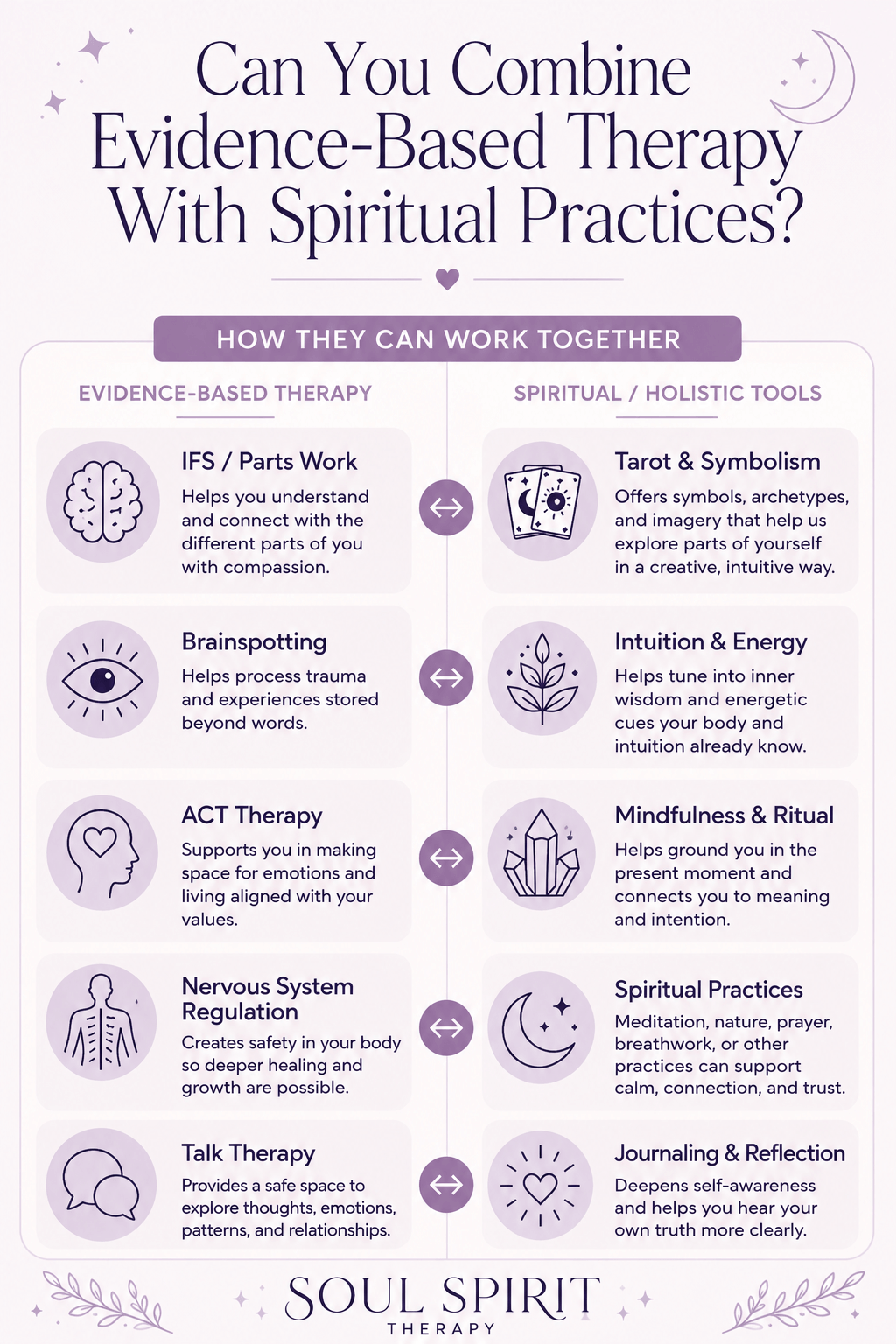
Absolutely! And this is where holistic therapy can be especially meaningful.
Spiritual practices don't have to replace traditional therapeutic approaches. Over 3,000 studies link spirituality with better mental health outcomes, including lower anxiety and depression. Instead, they can complement them.
For example, we might use Internal Family Systems (IFS) or Parts Work to become curious about a protective part of you and incorporate intuition or symbolism into that exploration.
We might use Brainspotting to process emotional experiences held beyond conscious thought while also exploring the meaning you're making from those experiences.
Acceptance and Commitment Therapy (ACT) may help you make space for difficult emotions while reconnecting with your personal values and the kind of life you want to create.
And nervous system regulation can help create the internal safety that makes deeper emotional and spiritual exploration possible.
The holistic tools don't need to compete with therapeutic ones. When used thoughtfully, they can support symptom relief and help you better understand mental health symptoms while existing side by side.
Do I Have to Be Spiritual to Work With a Holistic Therapist?
No.
You don't need tarot cards on your nightstand, an astrology app on your phone, or a favorite moon phase to benefit from holistic therapy.
And you should never feel pressured by a therapist to participate in a spiritual practice that doesn't align with your beliefs; they should approach spiritual topics with cultural humility and respect for your religious beliefs.
A holistic approach should be about making more room for who you are—not squeezing you into someone else's worldview.
If spirituality isn't important to you, therapy can focus on nervous system regulation, anxiety, ADHD, relationships, boundaries, emotional processing, or whatever brought you through the door.
If spirituality is important to you, there's space for that too. Clients who value a spiritual life often feel more understood when this part of their human experience is acknowledged respectfully.
What Can Spiritual Therapy Help With?
People seek spiritual or holistic therapy for many of the same reasons they seek traditional therapy.
You might be experiencing anxiety that makes it difficult to trust yourself. You may be navigating ADHD and realizing how much of your identity has been shaped by masking. Perhaps you're exhausted from people pleasing, struggling with burnout, processing trauma, moving through grief, facing substance abuse recovery, or trying to make sense of other life transitions when spiritual needs feel especially present.
Sometimes the feeling is harder to name.
For some people, religious involvement or connection to shared values in a spiritual or religious community can ease isolation during mental health struggles.
You just know you've become disconnected from yourself.
You're functioning. You're doing all the things. Maybe you're even doing them exceptionally well.
But something inside you keeps whispering:
There has to be more than this.
Therapy can give us a place to listen, find comfort in illness and loss, and build a deeper understanding that supports spiritual well-being and helps us navigate life's challenges.
Finding Spiritual Therapy in Oregon
If you're searching for spiritual therapy in Oregon, it's okay to look for a therapist whose approach reflects more than your symptoms.
Ask potential therapists how they integrate spirituality into their work and how that fits into a personalized treatment plan, and whether those practices are optional. You can also ask what clinical approaches they use alongside holistic modalities and how they navigate differences in spiritual beliefs. Spirituality may involve a higher power, spirit guides, or no particular religion at all.
If you want guidance rooted in a specific faith tradition, christian counseling, religious counseling, or a referral to spiritual leaders may be a better fit. Most importantly, look for someone who makes you feel like you can bring your whole self into the room.
Your anxiety.
Your ADHD.
Your skepticism.
Your tarot deck.
Your questions about who you're becoming.
All of it.
Therapy Can Have a Little Magic Without Losing Its Grounding
I don't believe healing has to fit neatly inside one box, and I believe in your innate capacity for healing and personal growth.
Sometimes healing looks like learning how your nervous system responds to stress.
Sometimes it looks like meeting a protective part of yourself with compassion instead of criticism.
Sometimes it's finally setting the boundary.
And sometimes it's pulling a tarot card, noticing the story it awakens inside you, and following that thread somewhere unexpected.
Therapy and spirituality can work together without asking you to choose between evidence-informed support and addressing spiritual aspects of healing, including finding meaning that helps you navigate life's challenges, while honoring the parts that feel intuitive, creative, meaningful, or sacred to you.
For some people, this can also include spiritual experiences or a spiritual awakening during major life transitions.
If you're looking for a holistic therapist in Oregon who makes room for anxiety, ADHD, emotional overwhelm, nervous system healing, and your spiritual side, I'd love to connect.
Frequently Asked Questions About Spirituality and Therapy
Can spirituality and therapy actually work together?
Yes. Therapy and spirituality don't have to exist in separate worlds. A holistic therapist can incorporate spiritual beliefs and practices alongside evidence-informed therapeutic approaches, allowing you to explore your mental health, relationships, nervous system, intuition, and sense of meaning in a way that feels authentic to you. Spirituality can be part of the conversation without becoming a replacement for mental health care.
What is spiritual therapy?
Spiritual therapy is an approach that makes room for a person's spiritual beliefs, practices, and experiences as part of the therapeutic process. Depending on the therapist and what feels meaningful to you, this might include mindfulness, intuition, tarot, meditation, nervous system work, or conversations about purpose and connection alongside more traditional therapeutic approaches.
Can a therapist really use tarot cards in therapy?
Yes, some therapists incorporate tarot as a tool for reflection rather than prediction. A card might become a starting point for exploring an emotion, relationship pattern, internal conflict, or part of yourself that has been difficult to put into words. In this way, tarot can complement approaches like IFS Therapy, where curiosity about the different parts of ourselves can help us better understand our emotional experiences.
How can I tell the difference between intuition and anxiety?
Intuition and anxiety can sometimes feel surprisingly similar, especially if you're used to being hyperaware of your environment or anticipating what might go wrong. Anxiety often comes with urgency, repetitive thoughts, or a need for certainty, while intuition may feel quieter and less demanding—but there isn't a perfect formula. Anxiety Therapy can help you become more familiar with your own patterns, nervous system responses, and internal cues so you're better able to understand what you're experiencing.
Do I have to be spiritual to work with a holistic therapist?
Not at all. Holistic therapy simply means making room for the whole person rather than focusing on a single symptom in isolation. You might love tarot, astrology, and intuitive practices, or none of those things may resonate with you. Therapy should meet you where you are, and any spiritual practices included in your sessions should be based on what feels supportive and meaningful to you.

About Tori Gorman
Clinical Social Work/Therapist, MSW, LCSW, LICSW
Tori is a licensed therapist and founder of Soul Spirit Therapy, providing virtual therapy for adults throughout Oregon. She specializes in supporting neurodivergent adults navigating ADHD, anxiety, burnout, trauma, nervous system dysregulation, and life transitions through a holistic, affirming approach that integrates evidence-based therapies with nervous system regulation, Brainspotting, Internal Family Systems (IFS), and intuitive practices. Tori is passionate about helping sensitive, deep-feeling humans reconnect with themselves, heal from survival mode, and build lives that honor the way they naturally move through the world.
If you're looking for compassionate, neurodivergent-affirming therapy in Oregon, schedule a consultation to learn more about working together.