


You arrive at work with your coffee, organized planner, and a mental checklist of everything you need to accomplish. You smile at your coworkers, contribute to meetings, and appear to have everything under control.
What nobody sees is the time you spent rehearsing what to say, the five reminders you set so you wouldn't forget something, or the energy it takes to stop yourself from interrupting, fidgeting, or losing focus.
By the time you get home, you're exhausted. Yet everyone at work thinks you're thriving.
For many women, masking ADHD in the workplace means spending enormous amounts of energy appearing organized, attentive, and emotionally regulated while struggling behind the scenes.
As a therapist in Oregon who supports women navigating ADHD, anxiety, and emotional overwhelm, I often explore how exhausting it can be to constantly perform a version of yourself that feels acceptable to everyone else.
What Is ADHD Masking?
ADHD masking involves consciously or unconsciously hiding, suppressing, or compensating for ADHD-related traits to meet social expectations.
In psychology, masking describes behaviors used to conceal aspects of someone's natural presentation. For neurodivergent people, this might involve suppressing movement, copying social behaviors, or hiding difficulties with attention and organization.
Not every coping strategy is masking. Using a calendar to remember appointments is a helpful accommodation. Constantly checking that calendar because you're terrified someone will discover how forgetful you feel may reflect masking.
Why Is Masking in Women So Common?
Masking in women can begin with childhood expectations to be polite, organized, cooperative, and attentive. Girls who struggle with these expectations may learn to compensate through perfectionism, people pleasing, or overpreparing rather than asking for support.
These habits can follow women into adulthood, where professional expectations create even more pressure to appear capable.
These habits can follow women into adulthood, where professional expectations create even more pressure to appear capable. In our article How to Get an Adult ADHD Diagnosis: Why So Many Women Don't Realize They Have ADHD Until Adulthood, we explore how years of masking can make ADHD harder to recognize, particularly in high-achieving women.
6 Common Examples of ADHD Masking at Work
Many ADHD masking examples look like desirable professional qualities. The difference is often how much energy they require and whether they're driven by fear of judgment.
1. Overpreparing for Meetings
You spend an hour preparing for a 15-minute meeting because you're worried you'll forget your thoughts or struggle to respond spontaneously. Preparation is helpful, but needing to rehearse every possible interaction can become exhausting.
2. Hiding Forgetfulness
You have multiple calendars, detailed planners, and dozens of phone reminders. These tools genuinely help, but you're constantly anxious that one mistake will reveal how hard you're working to stay organized.
3. Suppressing Movement
You concentrate better when doodling, standing, or fidgeting, but force yourself to sit perfectly still because you're afraid movement looks unprofessional.
4. Pretending to Understand Instructions
Your manager explains a project, and you nod confidently even though you've missed several details. Instead of asking for clarification, you spend the afternoon trying to reconstruct the conversation.
5. Working Longer Hours
You consistently meet deadlines, but only because you work late to compensate for procrastination, distractions, or difficulty starting tasks.
You consistently meet deadlines, but only because you work late to compensate for procrastination, distractions, or difficulty starting tasks. These struggles are often connected to executive functioning rather than a lack of effort, something we explore further in Executive Dysfunction vs. Laziness: What's the Difference?
6. Monitoring Your Personality
You constantly evaluate whether you're talking too much, making enough eye contact, interrupting, or appearing overly enthusiastic.
For some women, this self-monitoring becomes more exhausting than their actual responsibilities.
Social Mimicry, Scripting, and Mirroring as ADHD Masking Behaviors
Not all masking involves productivity. Some behaviors develop around navigating social expectations.
Social mimicry and scripting in ADHD can involve observing how others communicate and preparing your own responses accordingly.
Social mimicry might mean copying a coworker's tone, gestures, or communication style to appear more confident during meetings.
Scripting involves rehearsing conversations before they happen, such as practicing how to ask for clarification or disagree with your manager.
Mirroring in ADHD refers to adapting your communication style, energy, or behavior to match another person. You might become quieter around reserved coworkers or more outgoing around energetic ones.
These behaviors aren't exclusive to ADHD, and adapting socially is normal. They become worth exploring when you feel you must constantly change yourself to avoid rejection or criticism.
ADHD Masking at School: Where It Often Begins
For many women, ADHD masking at school started long before their first job.
Maybe you were the quiet student who never caused trouble but struggled to follow lessons. Or perhaps you earned excellent grades while spending twice as long on homework as your classmates.
Because you appeared successful, nobody noticed how much effort it required.
As an adult, those patterns may become overworking, perfectionism, difficulty asking for help, and feeling like you must constantly prove your competence.
The workplace may look different from the classroom, but the underlying fear can feel familiar: If I stop trying this hard, everyone will realize I'm not as capable as they think.
The Hidden Cost of Masking ADHD Symptoms in Women
Masking isn't always harmful, but constantly hiding your needs can take a toll on daily functioning and mental health.
Chronic anxiety: Monitoring your behavior, anticipating mistakes, and replaying conversations can leave you feeling tense even after work ends, adding a broader emotional toll and chipping away at self esteem when the self-monitoring never really stops.
ADHD burnout: Compensating for executive dysfunction, suppressing natural behaviors, and managing sensory overload can become unsustainable, sometimes leading to ADHD masking burnout and other negative consequences beyond work performance. Our article ADHD Burnout vs. Traditional Burnout: Why Rest Isn't Always Enough explores why recovery often requires more than taking time off.
Losing touch with yourself: When you're constantly adapting to other people's expectations, it can become difficult to recognize which behaviors feel authentic and which developed primarily to gain acceptance.
How Do You Recognize ADHD Masking Symptoms?
Common masking symptoms and patterns may include specific adhd masking behaviors, not just general stress or perfectionism:
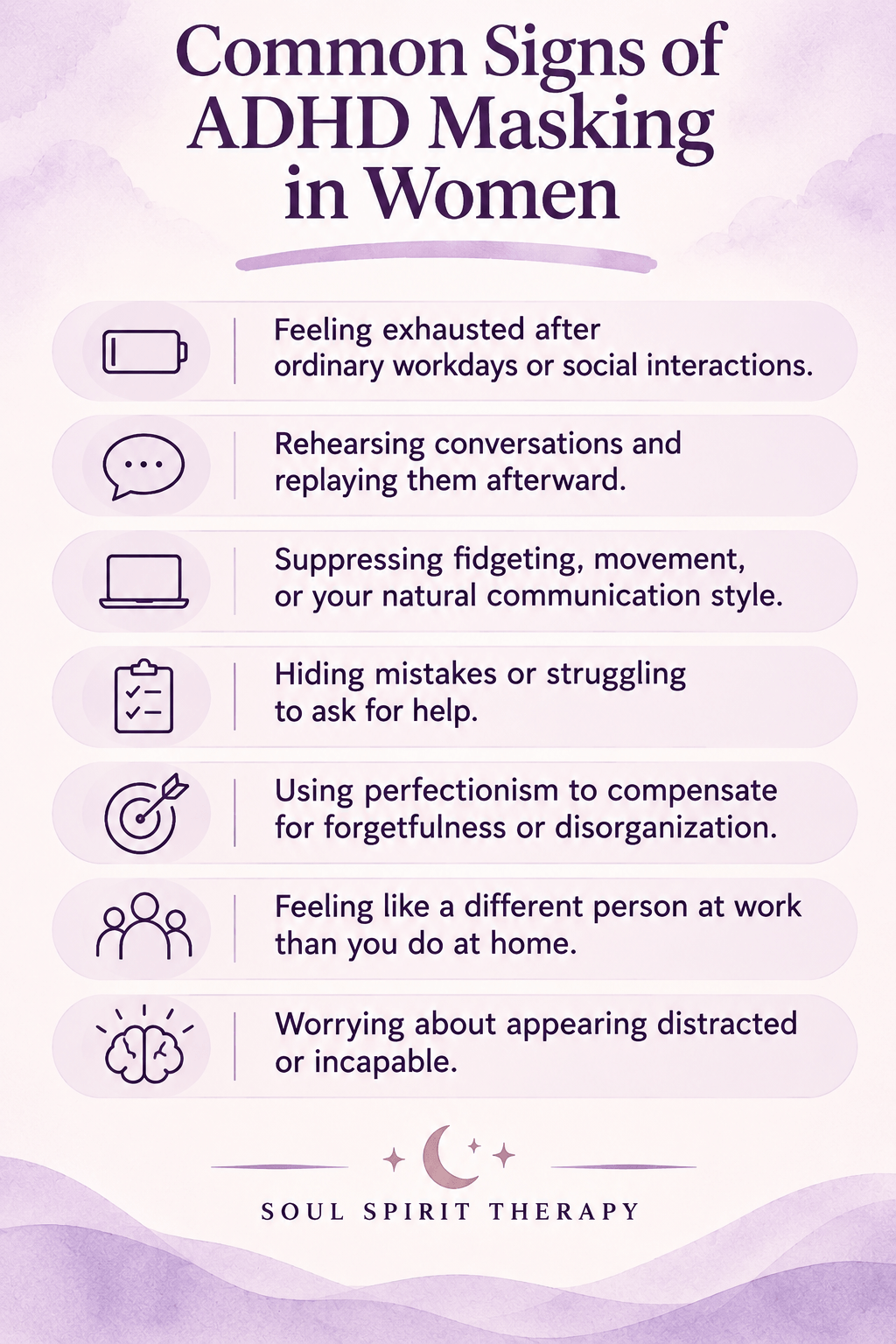
Feeling exhausted after ordinary workdays or social interactions, as many adults with undiagnosed ADHD do.
Rehearsing conversations and replaying them afterward.
Suppressing movement or other natural impulses in order to blend in.
Hiding mistakes or struggling to ask for help.
Using perfectionism to compensate for forgetfulness.
Feeling like a different person at work than you do at home.
Worrying constantly about appearing distracted or incapable.
These experiences aren't diagnostic criteria for ADHD and can overlap with anxiety, autism, trauma responses, and other conditions. However, they may help you recognize how much energy you're spending meeting expectations, and they can delay proper diagnosis, especially when strong coping strategies make ADHD less visible.
How to Stop Masking ADHD at Work: 6 Practical Strategies
Unmasking doesn't mean revealing every struggle or abandoning the strategies that help you succeed. Your privacy and professional boundaries matter, especially in workplaces that may not fully understand neurodivergence.
Instead, focus on small changes that make your workday more sustainable.
1. Separate Helpful Supports From Exhausting Habits
Ask yourself which behaviors are helpful coping strategies for your brain and which are unhealthy masking behaviors that mainly exist to hide your struggles.
For example, written reminders may be a coping mechanism that supports working memory when used kindly, or a fear-driven habit when they are used mainly to avoid judgment, while forcing yourself to sit completely still may drain energy without improving your performance.
Try making two lists: What supports me and What drains me. Notice where small adjustments might help.
2. Practice Low-Risk Unmasking
Start with changes that feel comfortable and appropriate for your workplace.
Allow yourself to doodle during meetings, ask someone to repeat instructions, or take a movement break when needed.
You might say, "I process information better when I can see it written down," instead of pretending verbal instructions always work for you.
You don't have to disclose your diagnosis to begin honoring your needs.
3. Create ADHD-Friendly Work Systems
Rather than relying on willpower, reduce the executive functioning demands of your workday.
Request written instructions or meeting summaries.
Break large projects into smaller tasks.
Use visual timers to help initiate work.
Schedule demanding tasks during your most focused hours.
Reduce unnecessary notifications.
Build transition time between meetings.
These strategies support your brain instead of asking it to function differently.
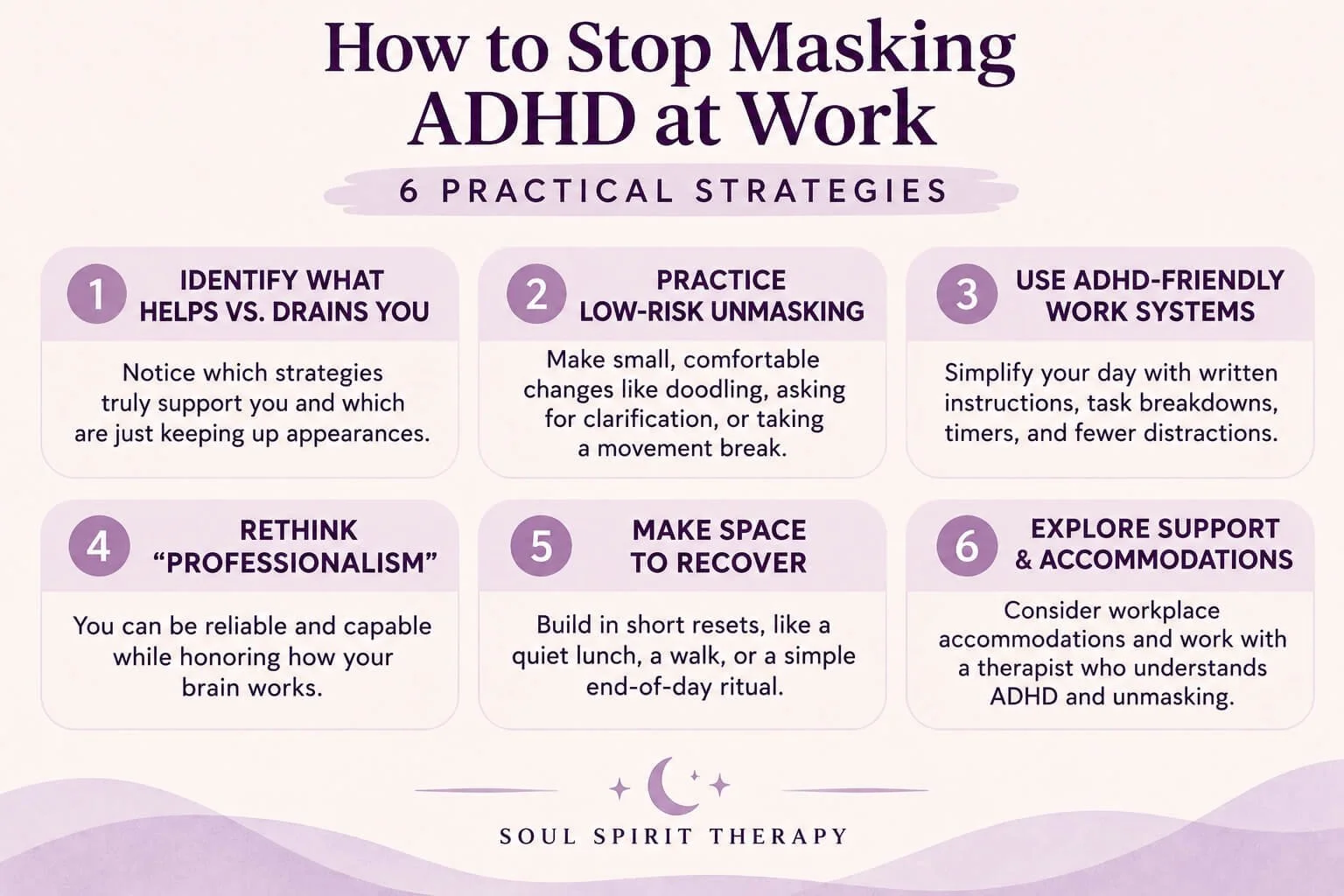
4. Challenge Your Definition of Professionalism
Does being professional require constant eye contact, sitting perfectly still, or never asking questions?
Not necessarily.
You can be reliable, thoughtful, and capable while processing information differently from your coworkers. Consider which expectations are essential to your job and which you've internalized out of fear of judgment.
5. Make Room for Recovery
If your workday involves significant social interaction, concentration, or sensory demands, intentional recovery matters.
Take lunch somewhere quiet, step outside between meetings, or create a transition ritual before heading into your evening.
Maybe that means making tea, lighting a candle, or pulling a tarot card to reflect on what you need.
The goal isn't another elaborate self-care routine. It's recognizing that your capacity is finite and deserves consideration.
6. Explore Accommodations and Professional Support
Depending on your needs, workplace accommodations might include written instructions, reduced distractions, modified communication methods, or adjustments to task structure.
ADHD may qualify for protection under the Americans with Disabilities Act when applicable criteria are met. Accommodation requests are individualized, and you don't need to share your diagnosis with every coworker.
ADHD Therapy and Neurodivergent Therapy can also help you explore workplace challenges, develop supportive strategies, and understand the emotional patterns connected to masking.
Can Therapy Help Women Unmask ADHD?
Therapy can provide space to explore the perfectionism, people pleasing, anxiety, and fear of rejection that often develop alongside years of masking.
For women who've spent years worrying about criticism or being perceived as “too much,” fear of rejection can become a powerful reason to keep masking. Our article Why Rejection Feels So Personal: Understanding Rejection Sensitivity in ADHD, Autism & Anxiety explores why perceived criticism can feel so intense and how to begin responding with greater self-compassion.
For some women, that means learning to communicate boundaries or recognize sensory needs. For others, it involves processing years of criticism and the belief that they're lazy, disorganized, or simply not trying hard enough.
Acceptance and Commitment Therapy (ACT) can help you develop a healthier relationship with self-critical thoughts while making choices that align with your values. When past experiences continue to influence how safe you feel expressing your needs, Brainspotting Therapy may also be incorporated into the therapeutic process.
In my practice, I make room for holistic and spiritual modalities when they're meaningful to you. Mindfulness, intuition, and nervous system awareness can support self-understanding without turning healing into another performance.
Because unmasking isn't about becoming a different person. It's about discovering which parts of yourself you've been hiding and deciding what you'd like to make room for again.
ADHD Therapy for Women in Oregon
If you're successful on paper but exhausted behind the scenes, you don't have to keep navigating that disconnect alone.
I offer ADHD and neurodivergent-affirming therapy for women throughout Oregon, including women with ADHD who are navigating masking, anxiety, emotional overwhelm, and burnout.
Together, we can explore the patterns you've developed and find ways to move through work and everyday life with less shame and more self-compassion.
You don't have to become less of yourself to be successful.
Frequently Asked Questions About ADHD Masking at Work
What are common examples of masking ADHD in women?
Common examples include adults with ADHD rehearsing conversations, suppressing fidgeting, hiding forgetfulness, or overpreparing to meet workplace expectations, along with working longer hours to compensate for executive functioning challenges. Particularly women may rely on these patterns for years before ADHD is recognized. Some women also use social mimicry or mirroring to navigate workplace expectations.
How do I know if I'm masking ADHD at work?
You may be masking if you spend significant energy hiding difficulties, monitoring your behavior, or trying to appear more organized than you feel. Feeling exhausted after maintaining a composed appearance throughout the day can also be a clue, although these experiences aren't exclusive to ADHD. In some cases, hiding symptoms can make an accurate diagnosis harder to reach, especially if you appear composed on the surface.
Is ADHD masking the same as people pleasing?
Not exactly. People pleasing involves prioritizing others' approval or comfort, and it may include emotional suppression or trying to maintain harmony, while ADHD masking is more specifically about hiding or compensating for ADHD-related traits. The two can overlap, particularly after years of criticism or pressure to meet expectations.
Can ADHD masking lead to burnout?
Sustained masking may contribute to exhaustion and burnout because of the mental load of constantly monitoring your behavior and trying to appear capable, especially when combined with executive functioning demands, sensory overload, and chronic stress. Recovery may involve reducing demands, accommodating your needs, and addressing the pressure to constantly appear capable.
Can I stop masking ADHD at work without disclosing my diagnosis?
Yes. You can begin with small adjustments such as requesting written instructions, taking movement breaks, or using organizational tools. Unmasking doesn't require sharing your diagnosis with everyone, and you can choose changes that feel appropriate for your workplace. Support from a healthcare provider can help you identify workplace adjustments and move toward a proper diagnosis or treatment plan if needed.

About Tori Gorman
Clinical Social Work/Therapist, MSW, LCSW, LICSW
Tori is a licensed therapist and founder of Soul Spirit Therapy, providing virtual therapy for adults throughout Oregon. She specializes in supporting neurodivergent adults navigating ADHD, anxiety, burnout, trauma, nervous system dysregulation, and life transitions through a holistic, affirming approach that integrates evidence-based therapies with nervous system regulation, Brainspotting, Internal Family Systems (IFS), and intuitive practices. Tori is passionate about helping sensitive, deep-feeling humans reconnect with themselves, heal from survival mode, and build lives that honor the way they naturally move through the world.
If you're looking for compassionate, neurodivergent-affirming therapy in Oregon, schedule a consultation to learn more about working together.