


You light the candle. Pull a tarot card. Take a deep breath. Maybe you journal about gratitude, repeat a few affirmations, and remind yourself that everything happens for a reason.
And yet, underneath all that beautiful intention, you're still angry about what happened yesterday. You're exhausted from constantly showing up for everyone else. Or maybe you're grieving something you haven't quite given yourself permission to feel.
So you try to shift your energy. Focus on the positive. Trust the universe. Raise your vibration.
But what if the most healing thing you could do in that moment wasn't to feel better? What if it was to let yourself feel what you're actually feeling?
This is where spiritual bypassing can sneak into our healing journeys, often disguised as positivity, personal growth, or spiritual enlightenment.
As a therapist in Oregon who integrates holistic and spiritual practices into mental health care, I believe spirituality can be a beautiful source of connection, meaning, and self-discovery. I also believe that our spiritual practices should help us become more connected to ourselves, not give us another reason to avoid the uncomfortable parts of being human.
Let's explore the spiritual bypassing meaning, how to recognize the signs, and what it looks like to embrace spirituality without abandoning your emotional needs.
What Is Spiritual Bypassing?
Spiritual bypassing is the tendency to use spiritual beliefs, practices, or explanations to avoid uncomfortable emotions, unresolved psychological wounds, relationship problems, or difficult realities. The term was coined by psychotherapist John Welwood in 1984 to describe how spirituality can sometimes become a way of avoiding important emotional work.
Meditation, prayer, tarot, astrology, and mindfulness can all be meaningful practices. But when they're used to consistently push away anger, grief, or fear, they may become a form of avoidance. There's a difference between saying, “I trust that I can find meaning in this experience” and “Everything happens for a reason, so I shouldn't be upset.” One makes room for your emotions; the other may unintentionally shut them down.
And here's something important: spiritual bypassing doesn't mean your spirituality is wrong or that you're intentionally avoiding healing. Often, these patterns develop because feeling our emotions has been overwhelming, unsafe, or discouraged in the past.
Sometimes, spirituality becomes another way we learn to protect ourselves.
What Are the Signs of Spiritual Bypassing?
Spiritual bypassing can be surprisingly difficult to recognize because many of its behaviors are socially celebrated. Being positive, forgiving, grateful, peaceful, and spiritually connected are generally considered good things.
But even beautiful practices can become unhelpful when they leave no room for the full range of human emotions.
Here are some common signs of spiritual bypassing to look for.
1. Feeling Pressure to Stay Positive All the Time
You might believe that negative emotions attract negative experiences, so you try to replace anger, sadness, or fear with gratitude as quickly as possible. Instead of acknowledging that something hurt, you remind yourself to focus on the lesson or raise your vibration. Gratitude can be a powerful practice, but it becomes unhelpful when you use it to avoid painful emotions rather than acknowledge them.
2. Using Spiritual Explanations to Avoid Difficult Conversations
Maybe you tell yourself that a challenging relationship is simply a karmic lesson or that the universe will resolve a conflict when the timing is right.
Sometimes these beliefs offer comfort. Other times, they can keep you from addressing unresolved issues, setting boundaries, communicating your needs, or taking the steps needed to solve problems in the relationship.
Spirituality shouldn't require you to ignore what someone's behavior is telling you.
3. Believing You've Healed Because You Understand the Lesson
You may intellectually understand why something happened or have developed a spiritual explanation that makes sense to you. But insight doesn't always mean you've emotionally processed an experience. You can believe something helped you grow and still feel hurt by it. You can forgive someone and still need boundaries.
4. Avoiding Anger Because It Feels Unspiritual
For many women, anger is already an uncomfortable emotion. We've often been taught to be agreeable, compassionate, understanding, and accommodating.
Add spiritual beliefs about peace, love, and forgiveness, and anger can start to feel like evidence that you're doing something wrong; jealousy and anger can seem like such things a “spiritual” person shouldn’t feel, so it's tempting to push them away.
But anger isn't automatically destructive. Sometimes it's an important signal that a boundary has been crossed, a need has gone unmet, or something in your life deserves attention.
The goal isn't to let anger control your actions. It's to understand what it's communicating, because learning from it supports true growth instead of shutting it down to avoid discomfort.
5. Using Spiritual Practices to Disconnect From Your Body
Meditation, breathwork, visualization, and other spiritual practices can help us feel more present, and a regular meditation practice may build mindfulness, self-awareness, and compassion. But sometimes people use them to disconnect from uncomfortable sensations, and that detachment from the body can be a sign of spiritual bypassing rather than a healthier relationship with those sensations.
You might immediately meditate whenever anxiety appears, not because you're making space for the experience, but because you're desperate to make it disappear; that may help temporarily, but it isn't a healthy long term strategy if it keeps you from returning to the underlying feeling with more capacity.
The difference can be subtle, and the same practice may be helpful in one situation and avoidant in another.
If you've noticed that your body reacts to stress even when your mind knows you're safe, our article Trauma and Your Nervous System: Why You Still Feel Unsafe Even When You're Not explores why those responses can linger and how nervous system regulation fits into healing.
Examples of Spiritual Bypassing in Everyday Life
Sometimes the easiest way to understand a concept is to see how it shows up in real life.
Here are a few examples of spiritual bypassing and what a more emotionally supportive response might look like.
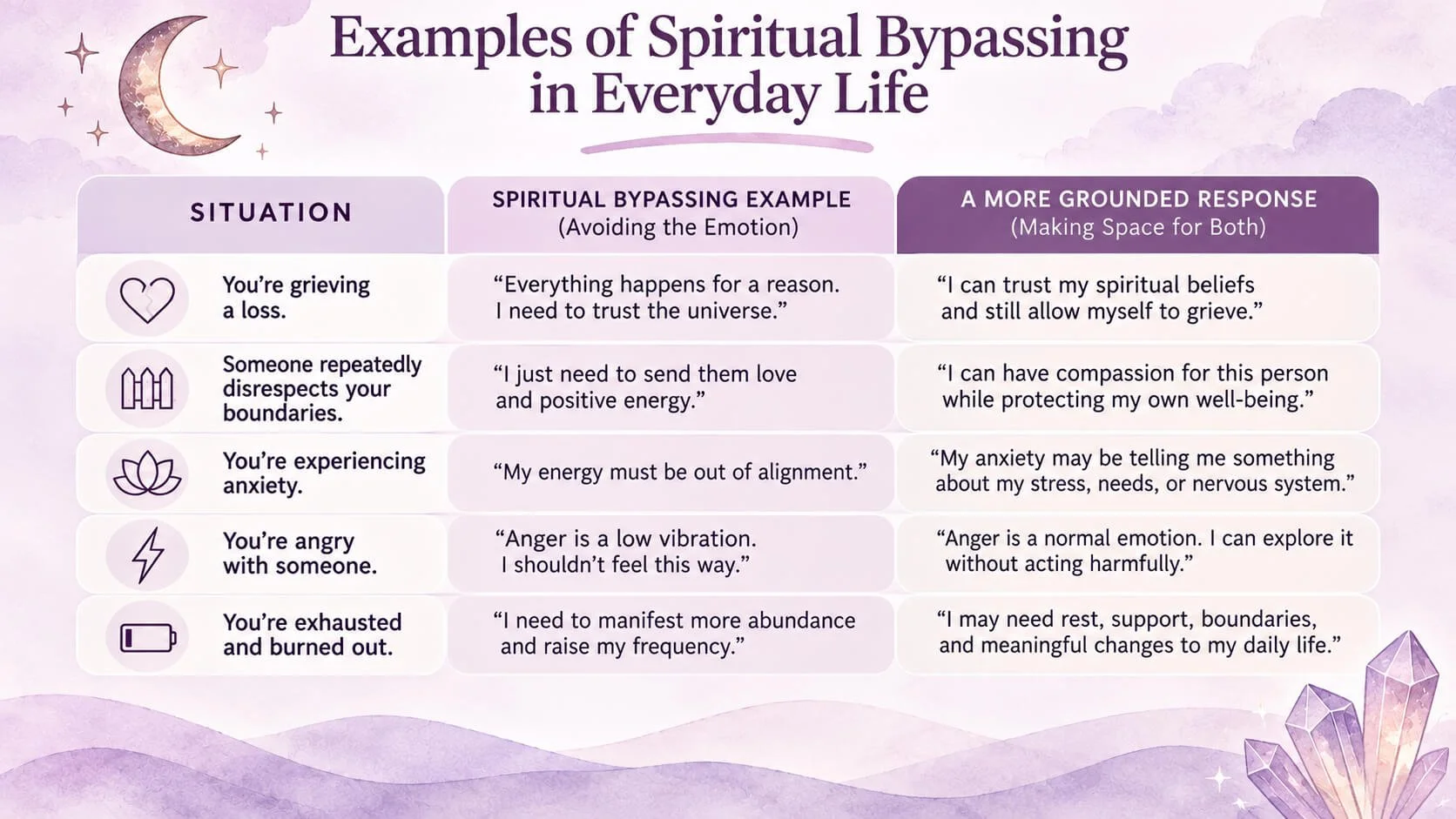
Notice that the grounded responses don't require abandoning spirituality. They allow spirituality to support the full human experience instead of bypassing it.
That's the kind of balance I love exploring in holistic therapy.
Spiritual Bypassing and Toxic Positivity: What's the Connection?
Spiritual bypassing and toxic positivity often overlap, but they aren't exactly the same thing.
Toxic positivity happens when there's pressure to maintain a positive outlook regardless of what someone is experiencing. It can sound like "just look on the bright side," "good vibes only," or "at least it wasn't worse."
Spiritual bypassing adds a spiritual explanation to that pressure. Instead of simply encouraging positivity, it may suggest that difficult emotions reflect a lack of faith, spiritual alignment, gratitude, or personal growth.
For example, imagine telling a friend that you're struggling with burnout.
A toxic positivity response might be, "Just focus on everything you have to be grateful for!"
A spiritually bypassing response might be, "You're attracting exhaustion because you're operating from a scarcity mindset."
Neither response makes much room for the fact that you're exhausted and need support. In some forms of wellness culture, that pressure overlaps with individualism by implying you should self-optimize past difficult or painful emotions instead of acknowledging them.
And if you're someone who already struggles with people pleasing, perfectionism, or feeling responsible for everyone else's emotions, these messages can reinforce the belief that you should always be able to manage your feelings independently.
You don't need to turn every difficult emotion into a positive affirmation. Sometimes the healthiest response is acknowledging that something is hard, especially when you're exhausted from constantly pushing through. As we explore in Burnout Recovery: It's Not Just About Working Too Much—It's About Living Against Your Nature, healing may require changing the expectations you're living under, not simply changing your mindset.
Spiritual Bypassing and Trauma: When Avoidance Becomes a Coping Mechanism
The relationship between spiritual bypassing and trauma deserves particular attention because avoidance isn't always a conscious decision.
If you've experienced trauma, emotional neglect, unpredictable relationships, or environments where your feelings weren't welcomed, you may have learned that disconnecting from uncomfortable emotions was the safest option available. Perhaps you learned to stay positive because expressing anger led to conflict, or spirituality became a source of safety during an uncertain time. Those strategies may have helped you cope, but what protected you then might not always support you now.
For some people, spiritual explanations involving soul contracts, karmic relationships, or divine timing can become a way to avoid acknowledging harm or processing difficult experiences. There's nothing wrong with finding spiritual meaning in what you've been through. The concern arises when those explanations prevent you from addressing unresolved emotions, seeking support, or recognizing how past experiences continue to affect you.
In therapy, we can explore the protective patterns you've developed without judging them. Approaches such as Brainspotting Therapy may be incorporated to help you explore emotional experiences and body-based responses that feel difficult to access through conversation alone.
Understanding why something happened doesn't always change how your body responds to it. Our article Trauma Stored in the Body: Why Talk Therapy Isn't Always Enough explores why emotional healing sometimes involves more than intellectual understanding.
Spiritual Bypassing in Spiritual Beliefs, Christianity, and Other Religious Traditions
Although spiritual bypassing is often discussed in connection with manifestation, astrology, meditation, and New Age spirituality, it can appear across traditions whenever spiritual concepts or spiritual ideas are used to avoid emotional reality, and it can also show up within organized religious traditions.
Spiritual bypassing in Christianity, for example, might involve feeling pressured to forgive someone before you've had time to process the harm they caused, believing that anxiety reflects insufficient faith, or being told to pray harder instead of seeking mental health support.
Someone experiencing grief might hear that they should simply trust God's plan. A person in an unhealthy relationship might be encouraged to focus exclusively on forgiveness rather than acknowledging the need for safety, boundaries, or accountability.
Of course, prayer, forgiveness, faith, and religious community can also provide tremendous comfort, resilience, and meaning. The problem isn't Christianity or religion itself. It's when spiritual teachings are used in ways that dismiss emotional pain, discourage appropriate support, or pressure someone to remain in a harmful situation.
This can be particularly complicated in relationships where you're continually explaining away someone's behavior. Our article Why You Keep Attracting Emotionally Unavailable Relationships explores how attachment patterns, people pleasing, and the desire to maintain connection can make it difficult to recognize when your own needs aren't being met.
This distinction applies across many spiritual and religious traditions.
Healthy spirituality can make room for grief, anger, uncertainty, questions, and the messy process of being human. Mature spiritual development includes making room for suffering, not escaping it.
You don't have to choose between having faith and acknowledging that you're struggling.
Why Women, People Pleasers, and Neurodivergent Adults May Be Especially Vulnerable
Spiritual bypassing can happen to anyone, but it's especially worth exploring for women who have spent years prioritizing other people's comfort over their own emotional needs. If you're accustomed to being the understanding one, the forgiving one, or the person who always sees the best in everyone, spiritual teachings about compassion and unconditional love may unintentionally reinforce those patterns. You might begin believing that setting boundaries isn't loving enough or that expressing disappointment means you haven't done enough inner work.
For women with ADHD or other forms of neurodivergence, spirituality can sometimes become another set of expectations to meet. If you've spent years masking your natural responses or trying to appear more emotionally regulated than you feel, you may begin believing that enough meditation, manifestation, or positive thinking will finally make you the calm, organized version of yourself you think you're supposed to be.
But healing doesn't require becoming someone who never struggles.
Sometimes these patterns began long before spirituality entered the picture. In Inner Child Healing: Why Childhood Patterns Still Show Up in Adult Relationships, we explore how early experiences can shape people pleasing, emotional suppression, and the belief that keeping everyone else comfortable is your responsibility.
Through ADHD Therapy and Neurodivergent Therapy, we can explore what it looks like to honor your actual needs rather than using spirituality as another way to mask them. If you've spent years feeling like you should be able to manage everything, our article ADHD Burnout vs. Traditional Burnout: Why Rest Isn't Always Enough explores why constantly overriding your needs can become so exhausting.
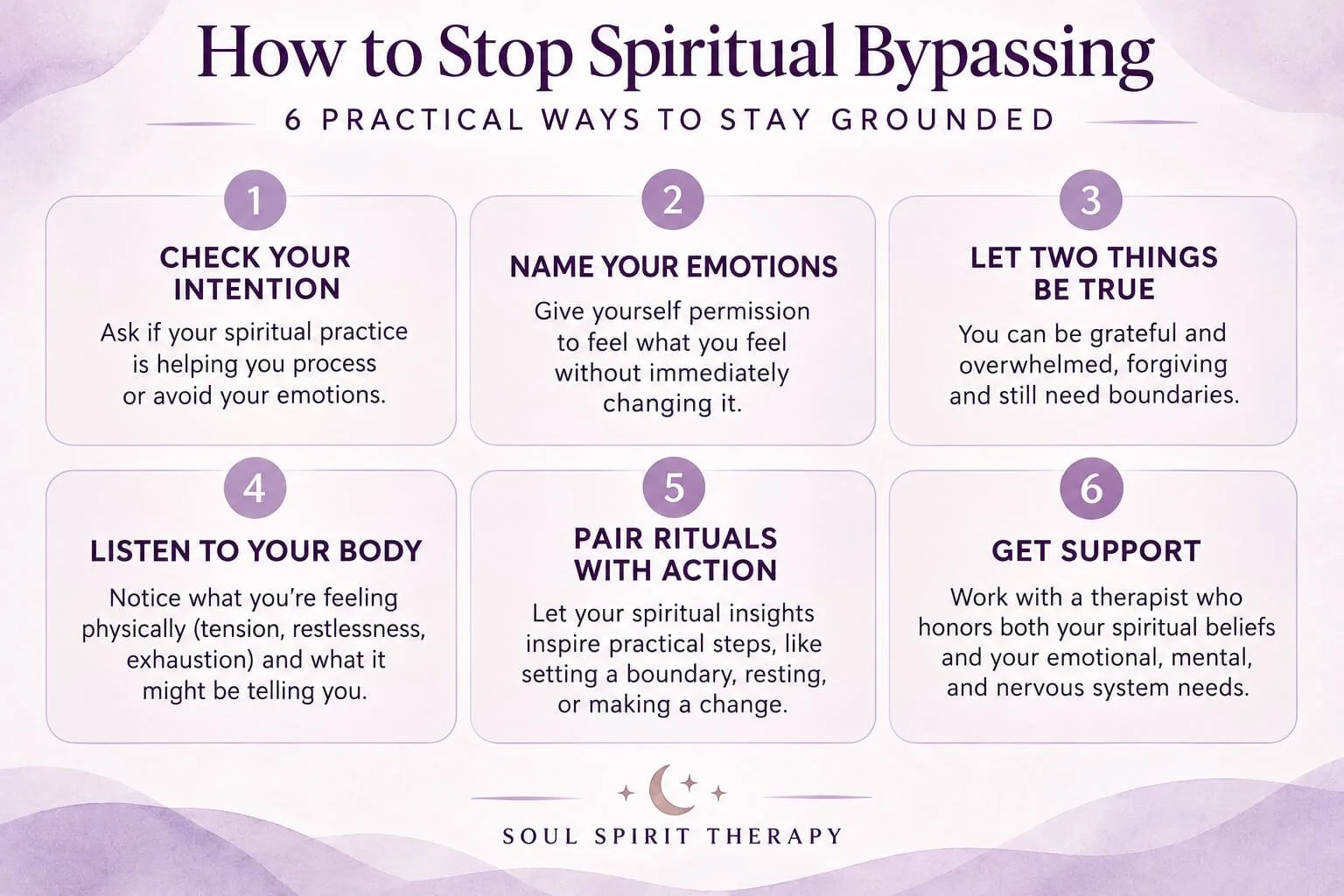
How to Stop Spiritual Bypassing: 6 Practical Ways to Stay Grounded
Recognizing spiritual bypassing doesn't mean you need to stop meditating, put away your tarot deck, or abandon the practices that help you feel connected to yourself.
Instead, the goal is to create a healthier relationship between your spiritual life and your emotional experiences.
Here are six ways to begin.
1. Ask Yourself Whether You're Processing or Avoiding
The next time you reach for a spiritual practice when you're upset, pause and ask yourself what you're hoping it will do.
Are you meditating because you want to become more present with your emotions, or because you desperately want them to disappear? Are you pulling a tarot card to explore a situation from another perspective, or because you're hoping it will make a difficult decision for you?
There's no need to judge the answer. Simply noticing your intention can help you understand whether you're using one's spirituality to stay present or to avoid facing unresolved emotional issues.
2. Practice Naming Your Emotions Without Immediately Changing Them
If you're accustomed to reframing everything positively, try allowing yourself to identify what you're feeling before deciding what to do about it.
You might say, "I'm feeling disappointed because I hoped this relationship would be different," or "I'm angry because I agreed to something I didn't actually have the capacity for."
You don't need to immediately replace those statements with gratitude or affirmations.
Naming an emotion can help you begin understanding it, even if the feeling doesn't disappear.
3. Let Two Things Be True at Once
One of my favorite ways to interrupt spiritual bypassing is to practice holding two seemingly contradictory truths.
You can be grateful for your life and still feel overwhelmed.
You can love someone and still need boundaries.
You can believe that difficult experiences contribute to growth and still wish they hadn't happened.
You can trust your intuition and recognize that anxiety sometimes makes it difficult to interpret your internal signals.
This both/and approach makes room for complexity instead of forcing every experience into a neat spiritual explanation.
4. Get Curious About What Your Body Is Communicating
Before trying to shift your energy, spend a moment noticing what's happening physically.
Are your shoulders tense? Is your breathing shallow? Does your stomach feel tight? Do you feel restless, heavy, disconnected, or exhausted?
You don't need to analyze every sensation or assume it has a deeper spiritual meaning. Sometimes your body is simply communicating that you're stressed, tired, hungry, overwhelmed, or in need of support. non attachment does not mean ignoring those sensations; it means noticing them without clinging or shutting down.
If focusing inward feels uncomfortable or activating, you can begin by noticing your surroundings instead. Grounding practices should help you feel more supported, not force you to confront sensations you're not ready to explore.
5. Pair Spiritual Rituals With Real-World Action
I love a meaningful ritual, but sometimes the ritual needs a practical next step.
If you pull a tarot card about boundaries, consider identifying one boundary you want to practice this week. If you journal during the full moon about releasing resentment, think about whether there's a conversation you've been avoiding or a responsibility you need to renegotiate.
If meditation helps you recognize that you're exhausted, perhaps the next step is adjusting your schedule rather than simply meditating more.
Your spiritual practices can inspire meaningful changes in your life, and they support personal responsibility when they lead to action rather than replace it.
6. Find Support That Makes Room for Both Spirituality and Psychology
You don't need a therapist who dismisses your spiritual beliefs, and you don't need one who interprets every emotional struggle through a spiritual lens; support should make room for both spirituality and psychology, including unresolved emotional issues, psychological wounds, and emotional healing.
A holistic therapist can help you explore the meaning you find in spirituality while also making room for trauma, anxiety, relationship patterns, emotional regulation, and the practical realities of everyday life.
Approaches like Acceptance and Commitment Therapy (ACT) can be especially helpful for learning to make space for uncomfortable emotions and stay with discomfort rather than simply avoid it, without allowing them to dictate every decision. Rather than trying to eliminate difficult feelings, ACT encourages psychological flexibility and taking meaningful action in alignment with your values.
That's a beautiful complement to spiritual practices that emphasize awareness, intention, and connection.
What Does Healthy Spirituality Look Like in Therapy?
Healthy spirituality doesn't require you to be peaceful, grateful, or emotionally regulated every moment of your life.
Sometimes it looks like lighting a candle and crying because you're finally allowing yourself to acknowledge how tired you are. Sometimes it's pulling a tarot card and realizing that the answer isn't hidden in the universe—you already know what you need, but you're afraid to act on it.
Other times, it means recognizing that no amount of meditation is going to make an unhealthy relationship healthy or an unsustainable schedule sustainable.
In my work with women throughout Oregon, I make room for both the spiritual and psychological sides of healing. We can explore tarot, intuition, mindfulness, nervous system regulation, and other holistic practices while also addressing anxiety, ADHD, trauma, emotional overwhelm, and the patterns that keep you feeling disconnected from yourself.
Our article Can Spirituality and Therapy Work Together? A Holistic Approach to Mental Health explores this relationship in more detail.
Because the goal isn't to use spirituality to avoid facing your own pain.
It's to develop a relationship with yourself where your emotions, needs, boundaries, and experiences are allowed to exist, and where healthy practice makes more room for difficult feelings, not less.
Even the uncomfortable ones.
Especially the uncomfortable ones.
Holistic and Spiritual Therapy in Oregon
If you've been using positivity, spiritual practices, or personal growth as a way to keep pushing through difficult emotions, you don't have to abandon those practices to begin healing.
Sometimes the next step is simply learning how to use them differently.
I offer holistic, spiritually inclusive therapy for women throughout Oregon who are navigating anxiety, ADHD, trauma, burnout, emotional overwhelm, and the feeling that they've spent years trying to become someone they're not.
Together, we can explore what's underneath the patterns you've developed, build a more compassionate relationship with your emotions, and find ways to honor both your spiritual beliefs and your very human needs.
Frequently Asked Questions About Spiritual Bypassing
What is the meaning of spiritual bypassing?
Spiritual bypassing means using spiritual beliefs, practices, or explanations to avoid dealing with uncomfortable emotions, psychological wounds, relationship problems, or difficult realities. It can involve using spiritual beliefs, practices, or explanations as a defense mechanism to avoid facing unresolved emotional issues, psychological wounds and unfinished developmental tasks.
What are some examples of spiritual bypassing?
Common examples of spiritual bypassing include telling yourself that anger is a low vibration, believing that anxiety means you're spiritually misaligned, rushing to forgive someone before processing what happened, or using manifestation practices instead of addressing practical problems. The key distinction is whether spirituality is helping you engage with your experiences or avoid them.
Is spiritual bypassing the same as toxic positivity?
Not exactly. Toxic positivity involves pressure to maintain a positive attitude regardless of your circumstances, while spiritual bypassing specifically uses spiritual beliefs or practices to avoid difficult emotions or realities. The two often overlap when people believe they must remain positive, grateful, or spiritually aligned instead of acknowledging genuine emotional pain.
Can spiritual bypassing interfere with trauma healing?
Yes. When spiritual practices are used to avoid facing unresolved emotional issues or painful emotions rather than processing them, they may interfere with trauma healing and opportunities to work through painful memories or protective responses. However, spirituality can also be a meaningful source of comfort and resilience during trauma recovery. Trauma Therapy can help you explore both your emotional experiences and the coping strategies you've developed without requiring you to abandon your spiritual beliefs.
How can spirituality and therapy work together without spiritual bypassing?
Spiritual bypassing and therapy don't have to go hand in hand. A spiritually inclusive therapist can help you incorporate meaningful practices like meditation, tarot, intuition, or prayer while also exploring difficult emotions, trauma, anxiety, and relationship patterns. The goal is to use spirituality as a source of connection and self-understanding rather than a way to avoid the parts of life that feel uncomfortable, so it supports emotional healing and authentic growth instead of bypassing unresolved issues.

About Tori Gorman
Clinical Social Work/Therapist, MSW, LCSW, LICSW
Tori is a licensed therapist and founder of Soul Spirit Therapy, providing virtual therapy for adults throughout Oregon. She specializes in supporting neurodivergent adults navigating ADHD, anxiety, burnout, trauma, nervous system dysregulation, and life transitions through a holistic, affirming approach that integrates evidence-based therapies with nervous system regulation, Brainspotting, Internal Family Systems (IFS), and intuitive practices. Tori is passionate about helping sensitive, deep-feeling humans reconnect with themselves, heal from survival mode, and build lives that honor the way they naturally move through the world.
If you're looking for compassionate, neurodivergent-affirming therapy in Oregon, schedule a consultation to learn more about working together.