

Burnout Recovery: It's Not Just About Working Too Much—It's About Living Against Your Nature

She wakes up tired, but there isn't really time to think about that.
Before her feet hit the floor, she's checking the calendar, mentally rearranging the day, remembering the email she forgot to send, and wondering whether she has enough groceries to make dinner.
By 8:00 a.m., she's already solved three other people's problems.
She's good at this.
At work, she's the person who gets things done. At home, she's the one who remembers the appointments, notices when the toilet paper is running low, plans the birthday gifts, responds to the school email, and somehow knows which child needs new shoes.
Her friends describe her as dependable. Her coworkers might call her a high performer.
But somewhere along the way, she quietly disappeared from her own life.
She can't remember the last time she did something simply because she wanted to. Rest happens only after everything else is finished—which means it rarely happens at all. And when she finally does sit down, her nervous system doesn't exactly get the memo.
Her body is on the couch. Her brain is still standing in the kitchen with a clipboard.
This is the kind of high performer burnout I see often as a therapist. And while workload certainly matters, burnout recovery is not just about doing less. It means recognizing when chronic stress has pushed you to override your needs, disconnect from your body's signals, and live in ways that don't fit your actual nature—then making the nervous system and life changes that support real recovery.
For a highly sensitive person, someone with ADHD, or a woman who has spent much of her life people pleasing, burnout recovery may require more than a vacation. It matters because burnout doesn't just leave you tired; it can leave you emotionally flat, physically depleted, and estranged from yourself in ways that keep causing harm if nothing changes.
It may require asking a much bigger question:
Does the life I've built actually work for the person I am?
In this article, we'll look at the signs of burnout, what can be mistaken for it, how chronic stress affects your nervous system, common burnout recovery stages, and practical ways to build a life that asks less of your body and leaves more room for you.
Burnout Isn't Always About How Much You're Doing
When we talk about burnout, the obvious solution seems to be doing less.
Burnout develops gradually; it doesn’t happen overnight.
Take some PTO. Cancel a few plans. Sleep more. Book the massage.
Those things can absolutely help.
But what if you're exhausted because you're not only doing too much—you're constantly doing things in ways that don't work for you under prolonged stress?
Maybe you're a highly sensitive person working in a loud, chaotic environment without enough time to decompress.
Maybe you have ADHDand spend your days forcing yourself into rigid productivity systems designed for a completely different kind of brain.
Maybe you're naturally creative and intuitive, but you've built a life where every minute needs to be productive.
Or perhaps you've spent years being the capable one. You anticipate everyone's needs, avoid disappointing people, and say yes automatically because being needed has become intertwined with feeling worthy.
That's a different kind of exhaustion.
Sometimes burnout is your body's way of saying, I cannot keep living this far away from myself—and the World Health Organization classifies it as an occupational phenomenon marked by exhaustion, increased mental distance, and reduced professional efficacy, rather than a medical disorder.
What Are the 7 Signs of Burnout?
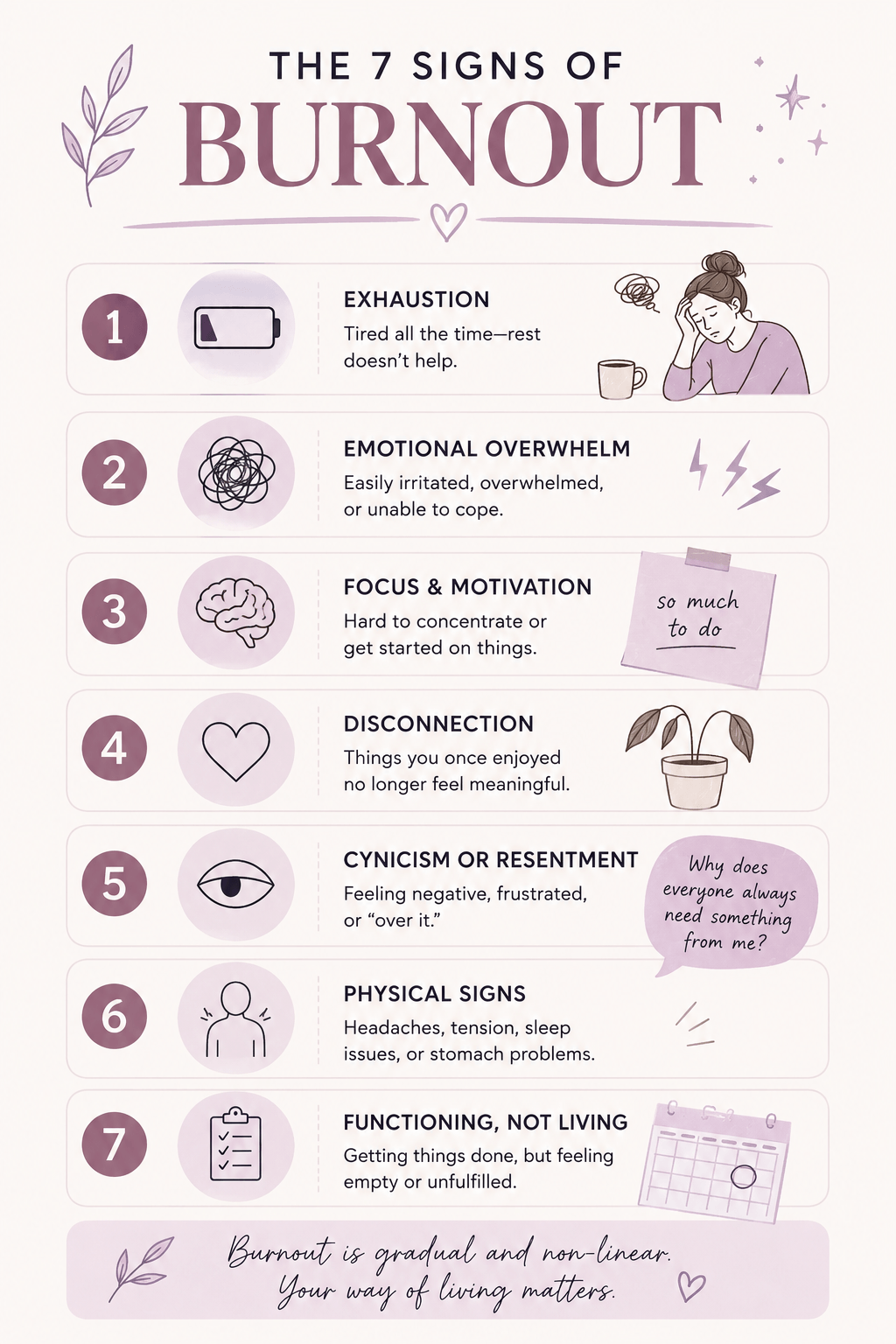
Burnout symptoms can include chronic fatigue and reduced professional efficacy. If those symptoms are persistent or severe, support can shorten burnout recovery by months compared with trying to manage it alone.
Burnout can look different from person to person, and there isn't one universal seven-item diagnostic checklist. But there are several burnout symptoms I frequently encourage clients to notice.
You may be experiencing burnout if you're noticing:
Exhaustion that doesn't seem to resolve with ordinary rest. You sleep, take a weekend off, or cancel plans and still feel depleted, with chronic fatigue that leaves you physically exhausted or in a state of mental exhaustion despite rest.
Emotional overwhelm or irritability. Small inconveniences suddenly feel enormous, and your tolerance for noise, interruptions, requests, or decisions becomes much lower, which can reflect emotional exhaustion.
Difficulty concentrating or initiating tasks. Things you used to handle easily require significantly more mental effort, and you may also feel exhausted by even basic responsibilities.
Disconnection from things you once cared about. Work, hobbies, relationships, or goals begin to feel flat, and losing interest can be an early sign that stress is becoming harder to carry.
Cynicism or resentment. You notice yourself thinking, Why does everyone always need something from me?
Physical signs of chronic stress. You may experience muscle tension, headaches, disrupted sleep, digestive changes, or a body that seems unable to fully settle.
Feeling like you're functioning rather than living. You're completing the tasks, meeting the deadlines, and checking the boxes, but you don't feel particularly present for any of it, and your sense of reduced professional efficacy may start to grow.
The important part isn't whether you can check exactly seven boxes. Burnout is often a gradual process, and it can unfold across twelve distinct phases in a non-linear way rather than as a neat checklist.
It's whether your current way of living feels sustainable.
What Is Often Mistaken for Burnout?
This is an important question because exhaustion, difficulty concentrating, irritability, and loss of motivation can have many causes.
Physical causes are part of the picture, but mental health issues and other mental health conditions can look similar too. Anxiety, depression, anxiety disorders, trauma responses, sleep problems, medical conditions, medication effects, and other mental or physical health concerns can sometimes resemble burnout. If you're experiencing significant or persistent changes in your energy, mood, sleep, concentration, or physical health, it's worth seeking professional help from an appropriate healthcare professional rather than assuming burnout explains everything. Chronic stress can lead to anxiety and depression symptoms, and 57 to 95 percent of adults with burnout also experience depression.
Neurodivergence can complicate the picture too.
For women with ADHD, what looks like ordinary burnout may involve years of masking, compensating for executive functioning differences, emotional dysregulation, sensory overwhelm, and forcing yourself to operate according to expectations that don't fit your brain.
I've written separately about ADHD burnout versus traditional burnout and why the distinction matters.
Highly Sensitive People May Need a Different Kind of Rest
If you're a highly sensitive person, your nervous system may process stimulation more deeply.
A packed day isn't simply a packed day.
It's the fluorescent lights, overlapping conversations, notifications, traffic, decisions, emotional energy of other people, uncomfortable clothes, background television, and the fact that somebody is somehow chewing very loudly three rooms away.
By evening, you may feel completely depleted even though you can't point to one particularly difficult thing that happened.
This is why burnout recovery can't always be measured by how many hours you're technically resting.
You may need:
Lower stimulation.
Solitude.
Time in nature.
Creative expression.
Movement that feels good rather than punishing.
Space where nobody needs anything from you.
Sometimes the question isn't, How can I become more resilient to this environment?
It's, Why am I continually asking myself to tolerate an environment that drains me?
Your Nervous System Doesn't Care How Impressive Your Calendar Looks
Your body keeps its own accounting system.
You can be successful, organized, productive, and deeply respected while your nervous system is operating as though you're constantly preparing for the next emergency.
With chronic stress, your body repeatedly activates its stress response and releases stress hormones to respond to perceived demands. Unlike acute stress, which usually passes once the situation ends, ongoing stress or constant stress can make slowing down feel strangely uncomfortable, weaken the immune system, and contribute to heart disease over time.
You finally get an empty Saturday and immediately think:
I should clean the garage.
You sit down to read and remember the laundry.
You book a massage and spend half of it thinking about what you'll do afterward.
This is one reason burnout recovery involves more than adding "self-care" to an already impossible schedule.
Your nervous system may need practice experiencing rest without immediately turning it into another task to accomplish, alongside practical stress management.
What Is the 42% Rule for Burnout?
You may have seen the 42% rule for burnout discussed online. The idea, popularized in conversations about stress and burnout, suggests that humans need roughly 42% of their time—or around 10 hours out of every 24—to be devoted to forms of rest and recovery.
That doesn't mean you need to spend ten hours lying perfectly still while someone feeds you grapes.
Sleep makes up a significant portion of that time. Recovery can also include movement, proper nutrition, a healthy diet, meaningful connection, affection, leisure, and activities that allow your body to shift away from constant demand.
I wouldn't treat 42% as a precise medical prescription or another target you're failing to hit.
Instead, use the idea as a thought experiment.
How much of your average day actually supports recovery?
Not productivity disguised as self-care.
Not answering emails while walking outside.
Not folding laundry while listening to a mindfulness podcast.
Actual recovery.
Your answer may tell you something, and supportive relationships plus social connection can also help reduce stress during recovery.
How Long Does It Take to Recover From Chronic Stress?
Unfortunately, there isn't a universal burnout recovery timeline.
If you've spent years operating under chronic stress, your nervous system probably isn't going to transform after one quiet weekend.
The recovery process can take 4-8 weeks for mild burnout, 3-6 months for more entrenched cases, and 1-3 years in severe burnout, depending on the severity and duration of your stress, your environment, your health, available support, and whether the conditions contributing to burnout have actually changed.
That's the last part people sometimes miss.
You cannot fully recover from an environment that continually recreates the problem without changing something about how you interact with that environment—or, when possible, the environment itself; removing major stressors and intervening early can shorten the time to recover from burnout by 50% or more.
This doesn't necessarily mean quitting your job, moving to a cottage in the woods, and becoming a woman who makes artisanal candles.
Although I support the fantasy.
It might mean establishing a boundary. Asking for help. Reducing sensory demands. Changing your schedule. Letting someone be disappointed. Unmasking. Building recovery time into your week before you reach your breaking point. In cases of mild burnout, that shift may start helping within a few weeks, while more severe cases often take much longer. Prioritizing sleep, improving sleep habits, and protecting sleep quality can also cut recovery time in half.
Burnout recovery is rarely one dramatic decision.
Often, it's dozens of small decisions that stop asking you to abandon yourself.
The Burnout Recovery Stages Aren't Always Linear
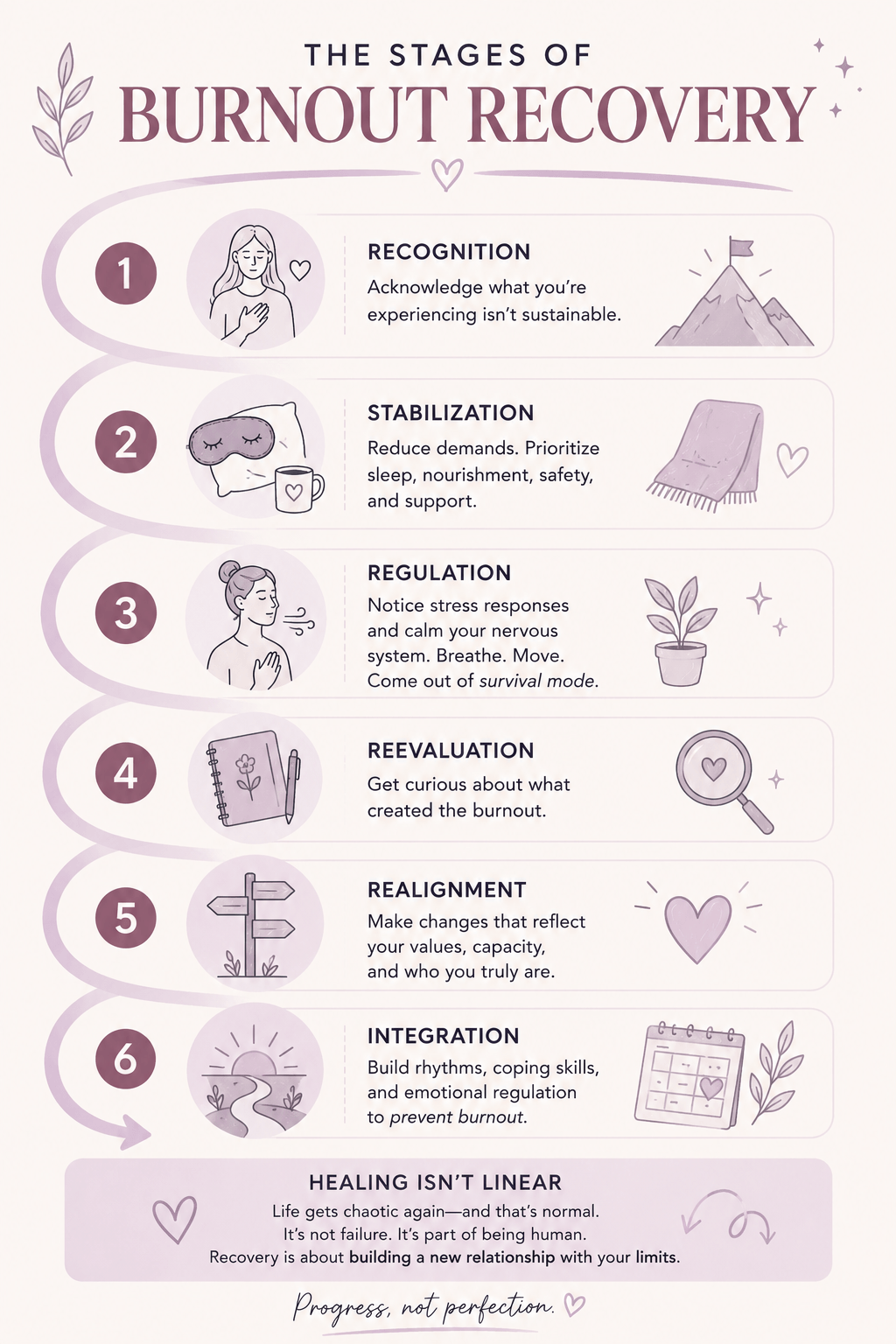
You may see different versions of burnout recovery stages online, but I prefer not to make healing another rigid staircase you have to climb correctly.
In practice, recovery often looks more like a spiral.
You may move through periods of:
Recognition
You finally acknowledge that what you're experiencing isn't sustainable, which is often true for people experiencing chronic stress and mental exhaustion from chronic overload.
Stabilization
You reduce immediate demands and prioritize basic needs such as sleep, nourishment, safety, and support; burnout recovery usually works best when treating it as recovery from chronic overload.
Regulation
You begin noticing your stress responses and experimenting with ways to help your nervous system settle; gentle movement and deep breathing can help move the body out of survival mode.
Reevaluation
You become curious about what created the burnout—not just how to recover from it.
Realignment
You start making changes that better reflect your actual capacity, values, neurodivergence, sensitivity, and desires.
Integration
You learn to notice your warning signs earlier and build rhythms that support you before exhaustion becomes a crisis, with coping skills and emotional regulation that help prevent burnout.
And then sometimes life gets chaotic again.
That doesn't mean you've failed.
Healing isn't never becoming overwhelmed again. It's developing a different relationship with your limits.
A Burnout Audit: What Is Actually Draining You?
If you're feeling burned out, try resisting the urge to immediately create a 12-step recovery plan.
Start with curiosity.
Take a sheet of paper or open your journal and divide it into three categories:
What Drains Me
Be specific.
Not just "work."
Maybe it's back-to-back meetings, switching tasks constantly, fluorescent lights, being available on Slack all day, managing other people's emotions, or never having uninterrupted time. Often, what looks like a simple busy schedule is really workplace stress, too many responsibilities, too much pressure, or too many pressures.
What Restores Me
Again, make this personal.
Perhaps the coping strategies that restore you include walking alone, sitting near water, reading fiction, gardening, creating something, pulling tarot cards, exercising, having an unhurried conversation, or drinking your coffee outside before anyone else wakes up. supportive relationships and social connections can be restorative because they significantly buffer against burnout stress.
What Am I Tolerating?
This is often the interesting one.
What have you accepted simply because you've convinced yourself you should be able to handle it?
A friendship that drains you?
A schedule with no margin?
Constant notifications?
Being the default person for everything?
Masking at work?
A home filled with visual clutter that overwhelms your senses?
Burnout recovery isn't only about removing responsibilities. Sometimes it's about noticing the tiny ways you've been overriding yourself every day.
Five Tangible Steps for Burnout Recovery
Once you understand what's contributing to your exhaustion, recovery becomes less about generic self-care and more about creating meaningful change.
1. Stop Waiting Until Everything Is Done to Rest
Everything will never be done.
There will always be another email, dish, appointment, project, or person who could use your attention.
Put recovery on the calendar before the leftovers of your life consume all the available space.
2. Create a "Minimum Viable Day"
Ask yourself what actually needs to happen on a difficult day.
Not your ideal day.
Not your hyper-productive day.
Your minimum viable one.
What can be postponed, simplified, delegated, or done imperfectly?
This can be especially helpful for ADHD brains that struggle with all-or-nothing expectations.
3. Reduce Unnecessary Nervous System Input
Turn off notifications.
Wear the headphones.
Dim the lights.
Take the quiet route home.
Spend ten minutes outside, or try gentle movement or regular exercise for stress reduction and to help your nervous system settle.
Decline the invitation.
Small reductions in stimulation can create meaningful pockets of space for a sensitive or overwhelmed nervous system.
4. Practice Disappointing People
This one isn't nearly as cute as buying a new journal, but it may be more transformative.
If people pleasing contributed to your burnout, recovery will probably involve allowing other people to occasionally experience disappointment.
You cannot simultaneously protect everyone from inconvenience and protect your own capacity.
5. Ask What You Actually Want
Not what would look impressive.
Not what your family expects.
Not what the productive version of you thinks you should want.
What does your body want?
What does your intuition keep nudging you toward?
What would your week look like if it were designed around your actual nature instead of your ability to endure things?
You don't have to immediately change your entire life, though recovery often requires lifestyle changes, not just insight.
Just start listening.
Sometimes Burnout Is an Invitation Back to Yourself
I don't believe burnout happens because the universe is sending you a cute little lesson wrapped in exhaustion. Sometimes difficult things are simply difficult, and spiritualizing suffering can prevent us from acknowledging what genuinely needs to change.
But I do think burnout can create an opportunity to become curious.
Maybe the version of you who could carry everything isn't the version you need to keep becoming.
Maybe your sensitivity isn't something to toughen out of yourself.
Maybe your ADHD brain doesn't need another planner.
Maybe productivity isn't the highest measure of a meaningful life.
And maybe rest isn't a reward you receive once you've finally become useful enough.
Holistic therapy can create room to explore those questions with professional support while also addressing anxiety, emotional overwhelm, nervous system regulation, boundaries, neurodivergence, and the patterns that make slowing down feel unsafe. Approaches like Cognitive Behavioral Therapy and Acceptance and Commitment Therapy can strengthen coping skills, support emotional regulation, and help clarify values during recovery.
Sometimes recovery isn't about getting your old energy back so you can return to the exact same life.
Sometimes it's about building a life that doesn't require you to disappear in order to maintain it. Starting therapy early can speed burnout recovery by months, sometimes cutting recovery time in half, and one-hour weekly sessions are a common structure.
Looking for Burnout Therapy in Oregon?
If this sounds familiar, and you're a high-performing woman who looks capable on the outside but feels exhausted underneath it all, you don't have to wait until everything falls apart before asking for support.
In therapy, we can explore what your burnout is communicating, identify the patterns keeping your nervous system stuck in chronic stress, and, with a licensed therapist, get professional help that supports a version of your life that honors your sensitivity, neurodivergence, intuition, and actual capacity.
You don't need to become better at enduring a life that continually drains you. You can learn to build one that feels more like yours.

About Tori Gorman
Clinical Social Work/Therapist, MSW, LCSW, LICSW
Tori is a licensed therapist and founder of Soul Spirit Therapy, providing virtual therapy for adults throughout Oregon. She specializes in supporting neurodivergent adults navigating ADHD, anxiety, burnout, trauma, nervous system dysregulation, and life transitions through a holistic, affirming approach that integrates evidence-based therapies with nervous system regulation, Brainspotting, Internal Family Systems (IFS), and intuitive practices. Tori is passionate about helping sensitive, deep-feeling humans reconnect with themselves, heal from survival mode, and build lives that honor the way they naturally move through the world.
If you're looking for compassionate, neurodivergent-affirming therapy in Oregon, schedule a consultation to learn more about working together.