

Why You Keep Attracting Emotionally Unavailable Relationships

Maybe you've noticed a frustrating pattern in your relationships.
You meet someone and the chemistry is immediate. They're intriguing, charming, and just mysterious enough to keep you wondering. One minute you're having a deeply intimate conversation at midnight, and the next you're staring at a text that hasn't been answered in two days.
When they're close, everything feels electric.
When they pull away, you can't think about anything else.
If you repeatedly find yourself in emotionally unavailable relationships, it can be tempting to ask, Why do I keep attracting these people?
But I want to offer a gentler question:
Why does this particular relationship dynamic feel so familiar to my nervous system?
Sometimes, emotional unavailability feels less like a red flag and more like chemistry because the uncertainty, longing, or need to earn connection mirrors relationship patterns your nervous system already knows.
As a therapist, I work with women who are incredibly self-aware, empathetic, intuitive, and accomplished—and still find themselves caught in relationships where they're doing most of the emotional work. Many are also navigating anxiety, ADHD, people pleasing, or old attachment wounds that make inconsistent connection feel especially difficult to walk away from.
This article is for you if you keep falling for the emotionally unavailable partner, find yourself consumed by relationship anxiety when someone pulls away, or wonder why you stay attached to people who can't consistently meet you emotionally. We'll explore the meaning of emotional unavailability, common emotionally unavailable signs, why attachment wounds and intermittent reinforcement can intensify attraction, the difference between an unhealthy attachment and trauma bonding, and how to begin changing these patterns.
What Does Emotionally Unavailable Mean?
Let's start with emotionally unavailable meaning, because the phrase gets thrown around a lot online.
Emotional unavailability generally describes difficulty engaging in emotional intimacy, vulnerability, or consistent emotional connection within a relationship (source).
That doesn't automatically make someone selfish, manipulative, or a bad partner.
Someone may struggle with emotional availability because vulnerability feels unsafe, they have their own attachment wounds, they're navigating stress or trauma, they never learned how to communicate emotions, or they simply don't have the capacity or desire for the kind of relationship you're looking for.
The important question isn't whether you can diagnose why they're unavailable.
It's whether the relationship you're actually experiencing meets your needs.
Sometimes we spend so much time trying to understand another person's wounds that we forget to notice what being with them is doing to ours.
Emotionally Unavailable Signs You May Notice in a Relationship
Emotional unavailability doesn't always look like someone refusing to talk about feelings.
In fact, an emotionally unavailable partner can sometimes be incredibly affectionate, romantic, or vulnerable—especially in the beginning.
The inconsistency is often what becomes confusing.
Some common emotionally unavailable signs include:
They're warm and connected one day and distant the next.
Vulnerable conversations happen, but don't lead to deeper consistency.
They avoid conversations about commitment or the future.
You frequently wonder where you stand.
They pull away when emotional intimacy increases.
Your needs are described as demanding, dramatic, or "too much."
Over time, that dynamic can wear down your self-esteem.
They share enough emotionally to make you feel close, yet you still feel lonely even when you're together because they rarely allow you to truly depend on them.
You find yourself making excuses for their lack of effort.
You're constantly analyzing their texts, tone, or behavior for clues about how they feel.
If you're searching for signs he is emotionally unavailable, pay attention to more than what he says.
Look at the pattern.
Does his behavior consistently create safety, trust, and emotional intimacy—or are you constantly trying to decode it?
Why Am I So Attracted to Emotionally Unavailable People?
This is where things get interesting.
We often assume attraction is evidence of compatibility.
Sometimes it is.
Sometimes attraction is recognition.
Your nervous system encounters something familiar and says, Oh. I know this dance—which can make a partner who is emotionally unavailable feel compelling because the pattern is familiar, not because it is healthy.
If love or attention felt inconsistent earlier in life, you may have learned that closeness involves pursuing, waiting, proving, anticipating, or earning.
Then you meet someone who is emotionally inconsistent and your nervous system lights up.
That doesn't necessarily mean they're your soulmate.
It may mean they know the choreography.
How Attachment Wounds Affect Emotional Connection in Adult Relationships
Attachment wounds can develop when important relationships don't consistently provide the safety, connection, or emotional responsiveness we need.
Maybe affection depended on your behavior.
Maybe a caregiver was physically present but emotionally distant.
Perhaps you became the "easy" child who didn't need much.
Or you learned to monitor everyone else's moods because knowing whether Mom or Dad was upset helped you feel safer.
Those adaptations don't magically disappear when you start dating.
As an adult, you may become highly attuned to changes in your partner's mood. You notice the shorter text. The slight shift in tone. The way they didn't say "love you" before hanging up this time.
And suddenly your nervous system is on the case like a tiny emotional detective who absolutely did not ask for the assignment.
This can create intense relationship anxiety, even when another part of you recognizes that constantly monitoring a relationship is exhausting.
People Pleasing Can Keep You Focused on Being Chosen
People pleasing can make emotionally unavailable relationships particularly difficult to navigate.
If you've learned to maintain connection by being accommodating, understanding, useful, easygoing, or endlessly patient, you may approach relationships by ignoring your own needs to reduce emotional demands on the other person and asking:
What do I need to do so this person chooses me?
You become more flexible.
You ask for less.
You convince yourself you're okay with casual when you want commitment.
You carefully word your needs so you don't scare them away.
You offer them enormous compassion for their emotional limitations while extending very little compassion to yourself for having needs in the first place.
Slowly, the relationship becomes centered around maintaining their comfort rather than evaluating your compatibility.
Healing asks you to turn the question around.
Instead of asking, "How can I get them to choose me?" what happens when you ask, "Do I choose this?"
Why Inconsistent Attention Can Feel So Addictive
One reason emotionally unavailable relationships can feel incredibly intense is something called intermittent reinforcement.
Intermittent reinforcement happens when a reward arrives unpredictably rather than consistently.
Think about the emotional experience of receiving almost nothing from someone for several days and then suddenly getting the message you've been hoping for.
Your entire mood changes.
There it is.
The affection, reassurance, attention, or connection you've been craving finally returns.
Because you don't know when you'll receive it again, you can become even more focused on obtaining it.
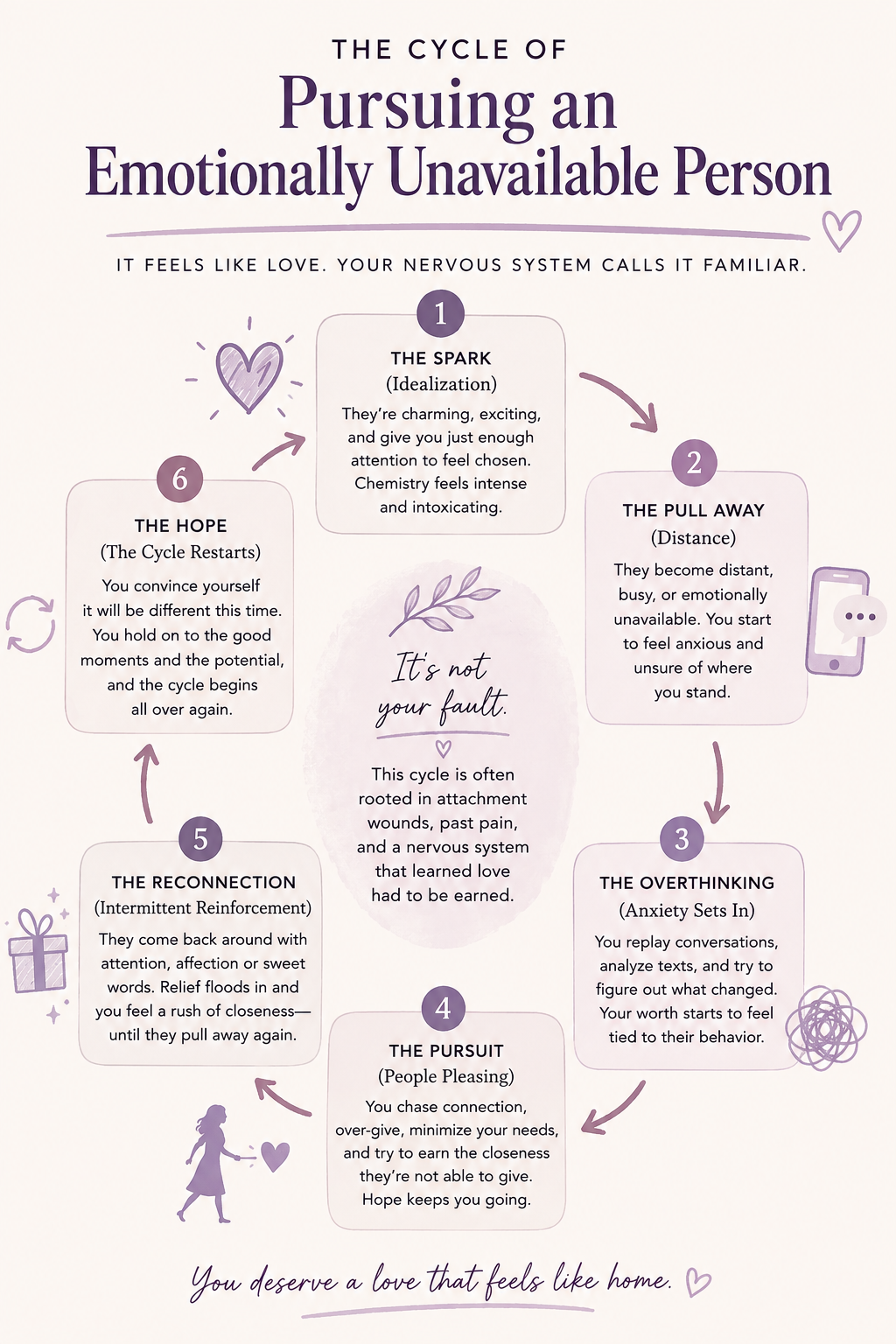
In relationships, this can create a painful cycle where one partner pursues connection, the other withdraws as the relationship deepens, and both get pulled into anxiety, pursuit, reconnection, and relief.
And relief can easily be mistaken for intimacy.
A healthy relationship may initially feel less intoxicating because your nervous system isn't constantly cycling between uncertainty and reassurance.
Calm doesn't always create butterflies.
Sometimes calm feels almost suspicious when you've learned to associate love with longing, and intensity can be mistaken for meaningful emotional closeness.
Is This Trauma Bonding?
The term trauma bonding is frequently used online to describe any intense or difficult attachment, but that's not quite what it means.
Trauma bonding generally refers to a powerful attachment that develops within an abusive relationship, particularly when mistreatment is interspersed with periods of affection, remorse, safety, or connection.
Intermittent reinforcement can play a role in that attachment.
But being attached to an emotionally unavailable person does not automatically mean you're experiencing a trauma bond.
You can have an anxious attachment.
You can be caught in an inconsistent relationship.
You can struggle to leave someone who isn't meeting your needs.
None of those things alone establish trauma bonding.
If you're experiencing coercion, control, emotional abuse, threats, or other forms of abuse, working with a qualified mental health professional can help you understand what's happening and explore your options safely.
When Relationship Anxiety Takes Over
One clue that an old wound may be activated is how much mental space the relationship begins occupying.
Maybe you're trying to work but checking your phone every few minutes.
You're rereading texts looking for a hidden meaning.
You ask three friends whether his message "sounds weird."
You open Instagram to see whether he's been active.
You start imagining the conversation you'll have if he leaves before there's even evidence he's going anywhere.
For women with ADHD or highly sensitive nervous systems, the emotional intensity can feel especially consuming. Difficulty shifting attention, rejection sensitivity, emotional dysregulation, and previous experiences of being misunderstood can all add layers to the experience.
This doesn't mean your concerns aren't valid.
Sometimes anxiety is highlighting a very real lack of consistency, and what you're dealing with is not just anxiety but real emotional distance.
That can feel genuinely hard when you're trying to tell whether the issue is an old wound or a current mismatch.
Therapy can help you learn the difference between an old wound being activated and your present-day self noticing that something genuinely isn't working.
Why Healthy Relationships Can Feel "Boring" at First
This can be one of the strangest parts of changing relationship patterns. You finally meet someone consistent. They text when they say they will, they're clear about liking you, and you don't have to spend half your evening decoding what they meant by a three-word text.
And instead of fireworks, your brain says, ...that's it?
When you're accustomed to emotional highs and lows, stability can initially feel unfamiliar. There isn't a three-hour gap to analyze, a mixed signal to decode, or a relationship puzzle to solve. If you're used to surface-level calm followed by emotional chaos, steady connection may not create the same immediate intensity.
That doesn't mean you should force yourself to date someone you're not attracted to. Chemistry matters. But it can be helpful to get curious about what you've historically called chemistry and how much uncertainty may have been wrapped up in that feeling.
Is it genuine connection? Or have unpredictability and the relief of finally receiving someone's attention sometimes felt like chemistry?
As you begin to experience relationships built on consistency and emotional availability, you may discover that meaningful chemistry doesn't always arrive as butterflies and intensity. Sometimes it grows more quietly through trust, safety, curiosity, and the freedom to be yourself without constantly wondering where you stand.
Healing the Part of You That Keeps Chasing
Changing relationship patterns isn't about teaching yourself to become detached or never need anyone.
It's about developing enough connection with yourself that you no longer have to abandon yourself to maintain connection with someone else.
In therapy, we may become curious about the part of you that desperately wants to be chosen.
What is she afraid will happen if this person leaves?
When has she felt this before?
What does she believe earning someone's love would prove, and can you be honest about what you fear, what you want, and what this pattern keeps stirring up?
Internal Family Systems (IFS) and Parts Work can be especially helpful here because rather than criticizing the part that keeps pursuing unavailable people, we get curious about what she's trying to protect. This kind of work can build self awareness and help you notice your own feelings and own emotions without judgment.
There may be another layer that doesn't respond to insight alone. You can intellectually understand your attachment patterns and still feel your entire body activate when someone pulls away.
Brainspotting can provide another avenue for exploring emotional experiences and patterns that feel deeply held, particularly when talking and analyzing haven't been enough.
Healing may also involve nervous system regulation, emotional regulation, mindfulness, boundaries, reconnecting with your intuition, and learning what safety actually feels like in your body.
Your Intuition Doesn't Have to Compete With Your Anxiety
One thing I love exploring with clients is the difference between intuition and anxiety.
Anxiety can be loud.
Figure this out.
Fix it.
Send another text.
Find out what they're thinking.
Intuition is often quieter.
Something about this doesn't feel good.
I'm asking for less than I actually want.
I'm exhausted.
This isn't enough for me.
When your nervous system is activated, fear can make it harder to hear yourself clearly.
Holistic therapy can make space for both: understanding the psychological patterns at play while also helping you reconnect with your body, your values, your intuition, and your sense of self.
You don't need a tarot card to tell you whether someone is emotionally available.
But sometimes slowing down enough to listen to your point of view and what actually matters to you feels a little bit like magic.
How Do You Stop Choosing an Emotionally Unavailable Partner?
There isn't a five-step formula that guarantees you'll never experience another disappointing relationship.
Healing is usually subtler than that.
It may mean noticing inconsistency without immediately trying harder to earn consistency. It can mean practicing boundaries and tolerating the discomfort of disappointing someone. It may involve learning to identify your needs and understand your attachment style before becoming deeply invested in another person's potential, especially if emotional unavailability tends to hook into old patterns.
You can also begin paying attention to how relationships feel in your body.
Do you feel free to be yourself, and do you feel safe being vulnerable?
Can you express a need without rehearsing it seventeen times first? When your partner responds, do they offer support or seem to feel overwhelmed by emotional conversations?
Can you disagree without fearing the relationship will disappear?
Do their actions generally match their words?
Are you connecting with the person who is actually in front of you—or with the version of them you're hoping they'll eventually become, where avoiding commitment is easier to excuse?
The goal isn't to become perfect at relationships.
It's to stop disappearing from your own.
You Are Allowed to Want a Love That Feels Safe
If you've spent years attracted to emotionally unavailable people, you don't need to shame yourself for it.
Those patterns may have made sense for a version of you whose childhood experiences or childhood wounds taught you that love was conditional and required pursuing, performing, waiting, fixing, or proving.
You can appreciate how those patterns once protected you without allowing them to choose your relationships forever.
You are allowed to want chemistry and consistency.
Emotional depth and dependability.
Mystery can be lovely in a tarot deck.
It doesn't have to be the defining characteristic of your relationship.
Ready to Explore Your Relationship Patterns?
If emotionally unavailable relationships, people pleasing, relationship anxiety, or old attachment wounds keep leaving you emotionally overwhelmed, feeling disconnected, or hurt, therapy can offer a place to understand these patterns without judgment.
As a therapist in Oregon, drawing on clinical experience, I work with women using evidence-informed therapy alongside holistic approaches such as Parts Work, Brainspotting, mindfulness, nervous system regulation, and intuitive exploration. This article is for educational and informational purposes, while therapy offers individualized support.
Together, we can become curious about what your patterns have been protecting—and how emotional unavailability shapes intimacy—so you can begin creating relationships where you don't have to abandon yourself to feel loved.

About Tori Gorman
Clinical Social Work/Therapist, MSW, LCSW, LICSW
Tori is a licensed therapist and founder of Soul Spirit Therapy, providing virtual therapy for adults throughout Oregon. She specializes in supporting neurodivergent adults navigating ADHD, anxiety, burnout, trauma, nervous system dysregulation, and life transitions through a holistic, affirming approach that integrates evidence-based therapies with nervous system regulation, Brainspotting, Internal Family Systems (IFS), and intuitive practices. Tori is passionate about helping sensitive, deep-feeling humans reconnect with themselves, heal from survival mode, and build lives that honor the way they naturally move through the world.
If you're looking for compassionate, neurodivergent-affirming therapy in Oregon, schedule a consultation to learn more about working together.